
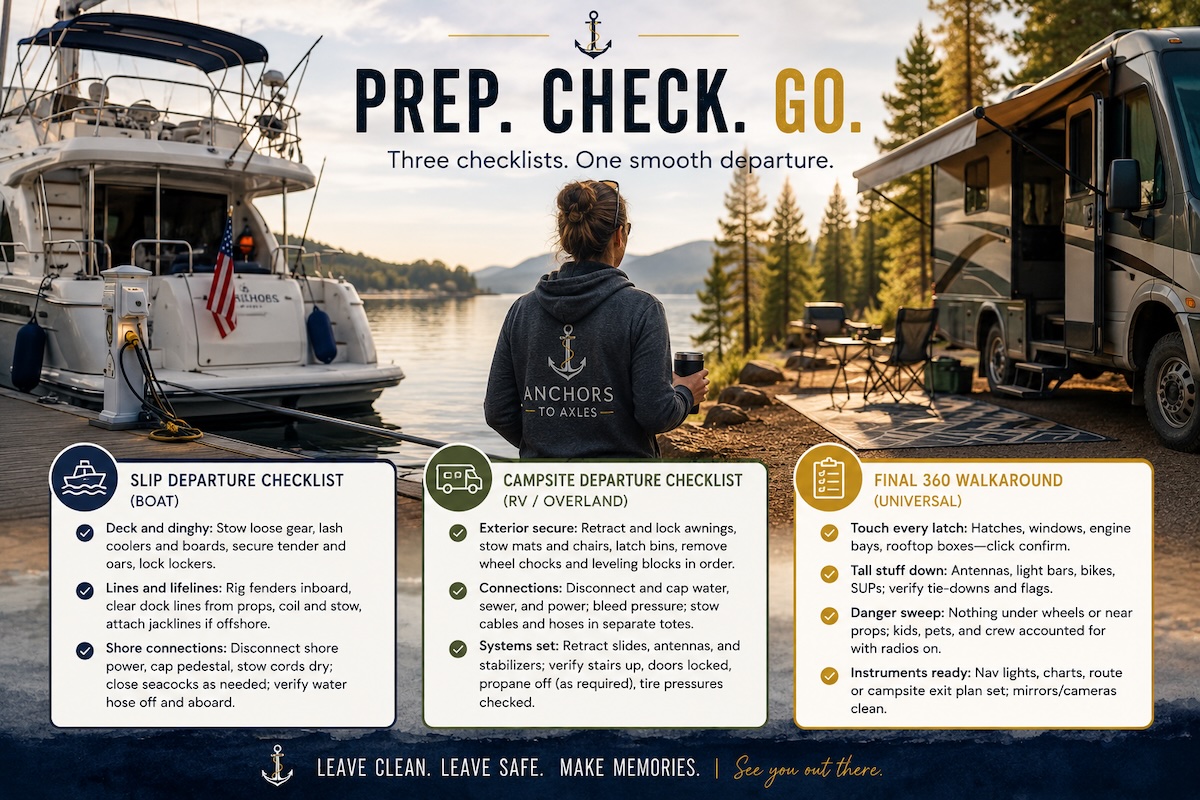
The 3 Pre-Departure Checklists That Keep Our Stuff Off the Bottom (and Our Rig in One Piece)
Leaving a marina slip or breaking camp at a gorgeous site is when things go sideways fastest. Lines in the water. Chairs on the highway. Awnings shredded in the wind. Someone yelling, “Did anybody grab the power cord?!”
We’ve done all of that. Once.
Now, whether we’re backing the RV out of a campsite or easing the 74’ Hatteras Empire out of a tight slip, we run three simple checklists every single time:
- Gear & Deck / Campsite Sweep – to keep stuff from going overboard or flying down the road
- Systems & Connections Check – to avoid forgotten shore power, hoses, and hookups
- Route & Conditions Brief – so we’re not surprised by a 25-knot headwind or a 10% grade
Think of these as our “anchors and axles” rituals — the practical side of the adventure that keep the fun from turning into an insurance claim.
1. Gear & Deck / Campsite Sweep
Goal: Nothing loose, nothing left, nothing launched into orbit.
Whether it’s cockpit cushions or camp chairs, the rule is the same: if it can move, it will.
On the water: boat deck sweep
Before we ever touch the throttles on Empire, one of us runs a fast bow-to-stern walk:
Outside / Deck:
-
Loose gear stowed:
- Dock lines not in use coiled and secured
- Fenders set or stowed (not dragging in the water)
- Boat hooks, brushes, buckets, grills, SUPs locked down or tied in
-
Cockpit & flybridge clear:
- Cushions snapped in or brought inside
- Fishing rods in holders with tips safe from snagging pilings
- Coolers latched; lids facing aft or strapped
-
Hatches & doors:
- All deck hatches dogged shut
- Lazarette and storage lockers latched
- Sliding doors closed and locked so they don’t slam in a wake
-
Tender & toys:
- Dinghy properly secured, drain plug in
- Outboard locked and fuel line disconnected if appropriate
- Kayaks / boards strapped with at least two attachment points
If something looks “temporary,” it’s not good enough for departure. Assume wake, wind, and your own prop wash will test every shortcut.
On the road: campsite sweep
Same idea, different view. Before the RV moves an inch, we circle the rig and truck.
Outside / Camp Setup:
-
Furniture & outdoor gear:
- Chairs, mats, tables, fire tools all packed
- Grills cool, cleaned, and stored (grease traps emptied)
-
Roof & ladder check:
- No stray towels, tarps, tools, or forgotten MAXXair fan covers
- Solar panels visually inspected for loose wiring or branches
-
Storage bays:
- All latches clicked shut and locked
- Heavy items secured so they won’t become projectiles on a hard brake
-
Truck bed & hitch area:
- Bikes, fuel cans, totes strapped or ratchet-strapped, not just “placed”
- Safety chains ready but not dragging; breakaway cable reachable but not too tight
This is where most of the “rookie mistakes” live. If we’re tired, we do this sweep together. One person points, one person touches. The goal: no “mystery thumps” on the highway.
2. Systems & Connections Check
Goal: No ripped awnings, forgotten shorelines, or dangling cords.
This is where the expensive mistakes hide. If you’ve ever driven away with your sewer hose still connected, you know.
Boat: lines, power, and seaworthy mode
Before leaving a slip, the boat goes from “floating condo” back to “ship.”
Dockside connections:
-
Shore power cords:
- Breakers off at the pedestal
- Cords disconnected at the pedestal and the boat
- Ends capped and stowed; route triple-checked so no line is still around a cleat
-
Water & sewer (if applicable):
- Freshwater hose disconnected, drained, and stored — not left draped on the dock
- Any pump-out hoses or adapters accounted for
-
Lines & fenders:
- Spring lines removed in a sensible order (never dropping the boat onto a piling)
- Remaining lines set for departure and final release
- Fenders positioned for exit, then later brought aboard & stored
Onboard systems:
-
Engine room:
- Seacocks in correct positions
- Bilge dry-ish and pumps tested
- Engine fluids checked (oil, coolant, gear oil where visible)
-
Interior:
- Windows closed, loose items secured, galley cleared for motion
- Fragile items either padded or moved low
This is where we avoid the “forgot to unplug shore power, now the cord is in the water” moment. One person calls out each item; the other visually confirms.
RV: awnings, slides, and hookups
The RV version is less salty, but just as critical.
Hookups:
-
Shore power:
- Main breaker off
- Cord unplugged from pedestal and RV
- Surge protector collected (easy to forget)
-
Water & sewer:
- Freshwater hose disconnected, drained, and stored (don’t forget pressure regulator and filters)
- Black and gray valves closed, caps on, hose rinsed and stowed
-
Cable / Starlink / external gear:
- Any coax or Starlink cables disconnected and coiled
- Pole mounts or tripods packed away
Awnings & slides:
-
Awnings retracted fully:
- Fabric rolled tight, no pooling water
- Arms locked or secured with straps if needed
-
Slides in:
- Visual check for obstructions: rugs, shoes, kids’ stuff, dogs (yes, really)
- Slide toppers rolled clean, not holding sticks or ice
If it protrudes from the side of the rig, it’s on this list. A shredded awning in 30 mph wind is a fast way to wreck a travel day.
3. Route & Conditions Brief
Goal: No surprises from wind, water, grades, or low bridges.
This is the mental checklist that keeps both the boat and the rig out of bad situations.
For the yacht: wind, current, and traffic
Before untying the last line:
-
Weather & wind:
- Direction and speed now, and forecast for the next few hours
- Any approaching storms or squalls that might hit while docking at the next stop
-
Current & tide:
- What’s the tide doing at departure and arrival?
- Any known cross-current in the fairway or inlet that will affect maneuvering?
-
Traffic & obstacles:
- Commercial traffic patterns (tugs, ferries)
- Bridges we need to time for openings or clearances
-
Plan B:
- Alternate anchorage or marina if things turn ugly or fill up
This doesn’t have to be a formal captain’s briefing. It can be a 3-minute conversation at the helm, but it saves you from “we didn’t realize the current would be on our beam” drama.
For the RV: grades, wind, and clearances
Before rolling out of a campground:
-
Route check (never just “trusting the car GPS”):
- Low clearances avoided (use RV-specific apps or offline tools)
- No surprise 12% grades or tight switchbacks for a heavy rig, if you can help it
-
Wind forecast:
- Crosswinds over 20–25 mph? Maybe adjust timing or route
- Big trucks + strong side gusts = white-knuckle day; we’d rather leave earlier or later
-
Fuel & stops:
- Where’s the first easy-in/easy-out fuel stop?
- Safe pullout options if weather turns or you need to check a tire or strap
We treat this like checking a weather window on the water. Same principle: respect physics, not your schedule.
Making It a Habit (So You Don’t Have to Learn the Hard Way)
None of these checklists are complicated. The magic is in actually running them every time, even when:
- You’re late
- You’re tired
- The weather looks fine
- You “only” moved for one night
That’s when chairs fly, cords drag, lines snag, and tempers flare.
At Anchors to Axles, the adventure lives in the space between the preparation and the chaos. The more dialed our checklists are, the more we can relax and laugh when the unexpected still punches through.
If you want more real-world yacht and RV checklists, gear breakdowns, and the stories behind what worked (and what didn’t) on Empire and on the road, stick around.
Subscribe to Anchors to Axles and come with us as we keep learning — one dock line and one campsite at a time.