
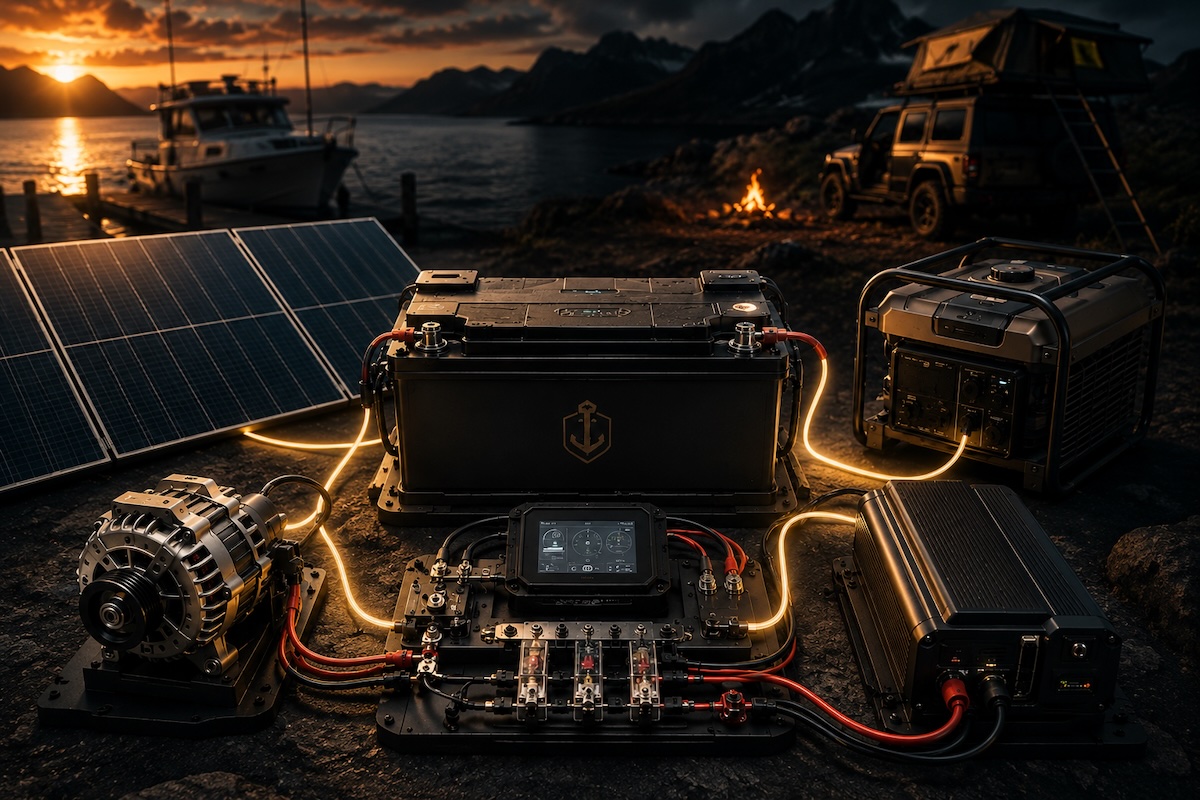
How to Pick Your First Off-Grid Power Setup: Solar, Alternator, Generator—or All Three
Power is freedom when you live between marinas and trailheads. Get it wrong and you’ve got a beautiful, mobile condo with dead batteries. Get it right and you’re charging cameras at anchor, running Starlink in the desert, and making coffee without begging for an outlet.
Here’s how we’d build a first off-grid power system for a boat or a rig—honestly, simply, and sized for your real life.
Start With Your Real Loads, Not the Shiny Gear
The right system starts with an energy audit. Ten minutes with a notepad now saves months of “why are we at 11.9V again?”
Quick Energy Audit (use Wh to keep it universal)
- List your devices: fridge, lights, fans, pumps, Starlink, laptops, induction/microwave, watermaker, etc.
- Write their power draw (W) and hours used per day.
- Multiply and add it up: watts x hours = daily watt-hours (Wh).
- Add 20–30% for losses and “whoops, forgot the router.”
Example day, no air conditioning:
- 12V fridge: 40W average x 12h = 480 Wh
- Starlink: 80W x 8h = 640 Wh
- Laptops/phones/cameras: 200 Wh
- Lights/fans/pumps: 200 Wh
- Total: about 1,520 Wh → round to 2,000 Wh with margin
Tip: Inverter overhead and device surges are real. A 1,500W inverter can idle at 15–30W. Turn it off when not needed or run more DC-native gear.
Size the Battery Bank for Autonomy First
Batteries are your buffer. Decide how many days you want to ride out clouds, shade, or a quiet anchorage.
- Convert Wh to Ah if you think in 12V: Ah = Wh / 12.
- For 2,000 Wh/day, two days of autonomy = 4,000 Wh.
- Lithium (LiFePO4) usable ~90%: choose ~4.5 kWh.
- That’s ~375 Ah at 12V, or ~190 Ah at 24V.
AGM/lead-acid? You’ll need roughly double the rated capacity for the same usable energy (50% DoD). Lithium costs more upfront but wins on weight, usable capacity, and charge rate.
Choose Your Chargers: Solar, Alternator, Generator
You want multiple ways to refill the tank. Think of it as a triangle—solar for steady baseline, alternator for transit days, generator for the ugly times.
Solar: Quiet baseline power
- Expect 4–6 peak sun hours on a good day. Real output ≈ panel watts x sun hours x 0.7.
- To cover 2,000 Wh/day: 2,000 / (5 x 0.7) ≈ 570W of panels.
- Boats: shading from rigs and radars can crater output; more smaller panels with an MPPT controller per array helps.
- Rigs: 400–800W on the roof is a sweet spot; add a 200W portable panel to chase sun at shady camps.
What works:
- MPPT charge controller sized for your array voltage/current
- Oversized wire and fusing to minimize voltage drop
- Tilt/portable options if you camp north or anchor under masts
Alternator or DC‑DC: Charge while you move
- Rigs: a 30–60A DC‑DC charger will safely feed lithium without roasting the factory alternator.
- Boats: a high-output alternator with an external regulator and temp sensors is gold. Lithium can demand more than your alternator can safely give—protect it.
- Rough math: 60A at 14V ≈ 840W. Two hours of driving ≈ 1.6 kWh back into the bank.
Generator: The weather‑proof sledgehammer
- Boats: a diesel genset pairs well with big inverter/chargers. It’s loud, but it runs A/C, watermakers, and tools.
- Rigs: a 2,000–2,500W inverter generator handles battery charging and short microwave/induction bursts.
- Use for high-draw loads or to recover after cloudy stretches. Respect neighbors and the quiet hours.
Fuel reality:
- Portable inverter gen: ~0.1–0.2 gal/hour at light loads.
- Marine genset: burns more but offers higher continuous output.
What We’d Pick for a First Setup
For a travel rig (no rooftop A/C on battery)
- Battery: 200–300Ah LiFePO4 (2.5–3.8 kWh)
- Solar: 400–800W roof + 200W portable if you boondock often
- Charging: 30–60A DC‑DC from alternator, 30–50A shore/gen charger
- Inverter: 2,000W pure sine (check surge for induction/microwave)
- Expectation: Laptops, Starlink, fridge, coffee, short microwave runs—yes. Air conditioning off-grid—no (unless you like hour-long naps and dead batteries).
For a cruising boat (no A/C at anchor)
- Battery: 300–600Ah at 12V or 200–400Ah at 24V LiFePO4 (4–10 kWh)
- Solar: 600–1,200W if you have the real estate
- Charging: High‑output alternator with external reg + 60–120A inverter/charger
- Generator: Strongly recommended if you run a watermaker, tools, or cook electric
- Expectation: Fridge/freezer, nav, lights, pumps, electronics, watermaker cycles—yes. A/C off solar—no. Use the genset or pick your weather.
If A/C is non‑negotiable: you’ll need a generator or a very large bank (10–20 kWh), big inverter (5kW+), serious charging, and realistic run‑time expectations.
Common Gotchas We Learned the Hard Way
- Parasitic loads add up: Starlink idle, inverters left on, routers, tank monitors. Kill what you don’t need.
- Shading slays solar: one radar shadow can drop a panel string to a trickle. Break arrays into multiple MPPTs.
- Alternator heat is real: lithium will happily overwork a stock alternator. DC‑DC or temp‑controlled external regulation saves hardware.
- Wire and fusing matter: voltage drop steals power; undersized wire cooks things. Use proper gauges, fuses, and busbars.
- Duty cycle beats nameplate: a 6A fridge isn’t pulling 6A all day. Estimate average draw over time.
- Charge profiles: set chargers for your chemistry (LiFePO4 is not AGM).
- Inverter surge: compressors and tools spike 2–3x their running watts—size for start‑up.
The Anchors-to-Axles Takeaway
Pick batteries for the life you actually live, then layer solar, alternator/DC‑DC, and generator to keep that bank happy in all conditions. For most first builds, a lithium bank + solid solar + alternator charging handles 80% of days. A generator covers the other 20% when weather, shade, or big loads show up. It’s not glamorous, but it works—and that’s what buys you the sunsets, the quiet coves, and the dirt roads worth remembering.
Want a second set of eyes on your power plan—or curious what we’re running on the water and on the road? Reach out to Anchors to Axles and subscribe for field-tested gear, build sheets, and honest lessons from the dock and the trail.