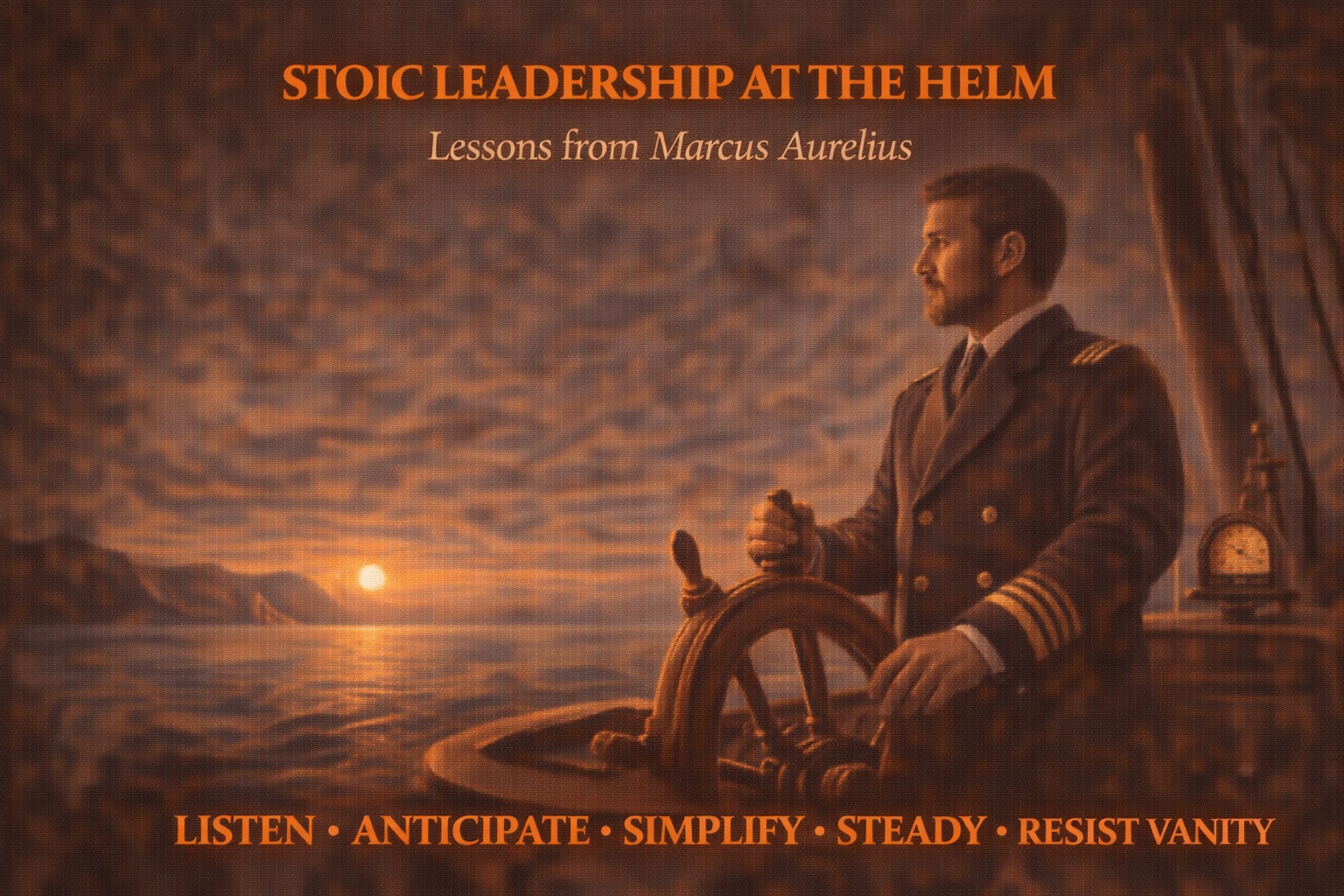
Stoic Leadership Under Load: Lessons from Meditations I.16
Book I, Section 16 of Meditations sketches a profile of leadership that is quiet, exacting, and durable. It is an operating standard more than a posture: rational deliberation, emotional moderation, and public duty bound together by restraint. Read as guidance for modern systems—technical, organizational, or personal—it offers a way to lead when uncertainty and scrutiny are constants.
Mildness without softness
“Mildness of temper” is not passivity. It is control of one’s own system so that judgment is preserved when the environment spikes. At sea, a skipper who raises his voice loses signal-to-noise when he most needs precision. In an incident bridge, the engineer who calls a calm halt and assigns a recorder buys the team oxygen. Mildness keeps the channel clear for action.
Train it:
-
Breathe, don’t broadcast. If your pulse speeds up, lower your voice.
-
Use standard phrases under stress. “Pause. State facts. Options. Decision.”
Resolution after real deliberation
Marcus praises “unchangeable resolution in the things determined after due deliberation.” Once the analysis is done, stop thrashing. In software, this is a go/no-go call after a pre-brief. In operations, it’s a departure window selected after weather routing. The leader accepts the residual risk and commits.
Practice:
-
Keep a decision log. Record context, options, chosen course, and reasons.
-
Pre-commit: once D-1 review is complete, changes require new information, not new opinions.
Justice without favoritism
“Giving to every man according to his deserts” is impartial administration. Performance reviews, promotions, and allocations should follow clear criteria, not proximity, charm, or familiarity. Marcus also frees his friends from obligatory attendance; he separates personal loyalty from institutional obligation.
Implement:
-
Publish decision criteria before the decision.
-
Avoid private channels for resource requests. Keep the process visible.
Inquiry beyond first appearances
He “never stopped his investigation through being satisfied with appearances which first present themselves.” In complex systems, the first explanation is usually incomplete. Root cause hides under convenience and ego. Leaders must create time and structure to look again.
Habits:
-
Require at least three plausible causes before converging.
-
Red-team major decisions. Invite someone who benefits from being wrong if the plan fails.
Knowing when to act and when to relent
He knew “the occasions for vigorous action and for remission.” Operating tempo is a lever. Crisis demands decisive force. Recovery demands patience. Burn both ends and systems crack; relax at the wrong moment and they flood.
Cadence:
-
Declare mode: pursue, stabilize, or recover. Align behavior and metrics to the mode.
-
Use stop-loss thresholds. When tripped, switch from pushing to protecting.
Quiet provision and long sight
He “foresaw things a long way off, and provided for the smallest without display.” Durable operations are built on unglamorous preparation: spares on board, backups restored and tested, handover notes that make sense in the dark. You don’t advertise it; you do it.
Make it real:
-
Run unannounced restore drills. If recovery fails, provisioning is theater.
-
Stock small parts and checklists where they are needed, not where they look tidy.
Resistance to vanity and novelty
He checked applause and flattery and avoided “love of novelty.” Vanity metrics—followers, headlines, feature counts—distort priorities. Chasing the new because it is new weakens systems. Adopt tools, including AI, only when they reduce noise and sharpen judgment.
Guardrails:
-
Applause audit: list three decisions made harder by praise; correct course.
-
Tool adoption test: does it lower error rates or decision time without hiding mechanism? If not, decline.
Enduring blame for frugal stewardship
He “economized the administration” and accepted the blame that followed. Real stewardship often looks like saying no: deferring features to pay down debt, refusing to expand scope at the expense of reliability, cutting ceremonial spend to fund maintenance. Expect criticism. Hold the line.
Principles:
-
Budget maintenance first. Protect it in downturns.
-
Explain the trade in plain language once; then execute without apology.
Steady friendship and ordinary citizenship
He kept friends without extravagance and considered himself “no more than any other citizen.” The leader who stays the same when others can’t make dinner—or when they fail him—builds trust. The leader who declines special exemptions keeps his edge. Privilege dulls perception.
Practicality:
-
Release people from performative loyalty: no obligatory social rituals.
-
Take your turn at the unglamorous work.
Sobriety toward gods and men
Neither superstitious nor ingratiating, he refused to buy favor with gifts or flattery. Substitute modern rites: cargo-cult process, dashboards built to reassure rather than inform, AI used as theater. Rituals are good when they reduce error; they are harmful when they replace thinking.
Checks:
-
For any ceremony, state its failure mode: how would we know it isn’t working?
-
For any model, state its kill-switch: when do we revert to human-first processing?
Using abundance without attachment
“The things which conduce to the commodity of life … he used without arrogance and without excusing himself.” Enjoy tools, budgets, and comforts without apology—and without dependence. If the gadget breaks or the budget tightens, competence remains.
Discipline:
-
Periodically operate in reduced mode: fly blind sim, paper checklists, manual failover.
-
Treat AI as augmentation: the operator stays accountable for decisions and outcomes.
Practices to train practical virtue
-
Daily inquiry: write one assumption you revised and why. Cultivate second looks.
-
Decision cadence: deliberate hard, decide once, revisit only on evidence.
-
Temper drills: rehearse crisis comms with a calm script and a recorder.
-
Fairness by design: public criteria, open forums, clear appeals.
-
Provision quietly: test restores, rotate spares, walk the deck before the storm.
-
Applause and novelty guards: remove one vanity metric from your dashboard; add one durability metric.
-
Automation boundaries: document when a tool may override human input; default to human veto.
What modern leadership can borrow from Marcus
Stoic leadership is not an attitude; it is a system. Reasoned judgment sets direction. Emotional moderation keeps signal high. Public duty aligns individual restraint with collective resilience. In software, on the bridge, or in a boardroom, the pattern holds: decide after thinking, act without drama, provision without show, and let the work—not the noise—speak.
If this lens helps you lead under real constraints, explore more essays and field notes from The Rissler Perspective or subscribe for future pieces.