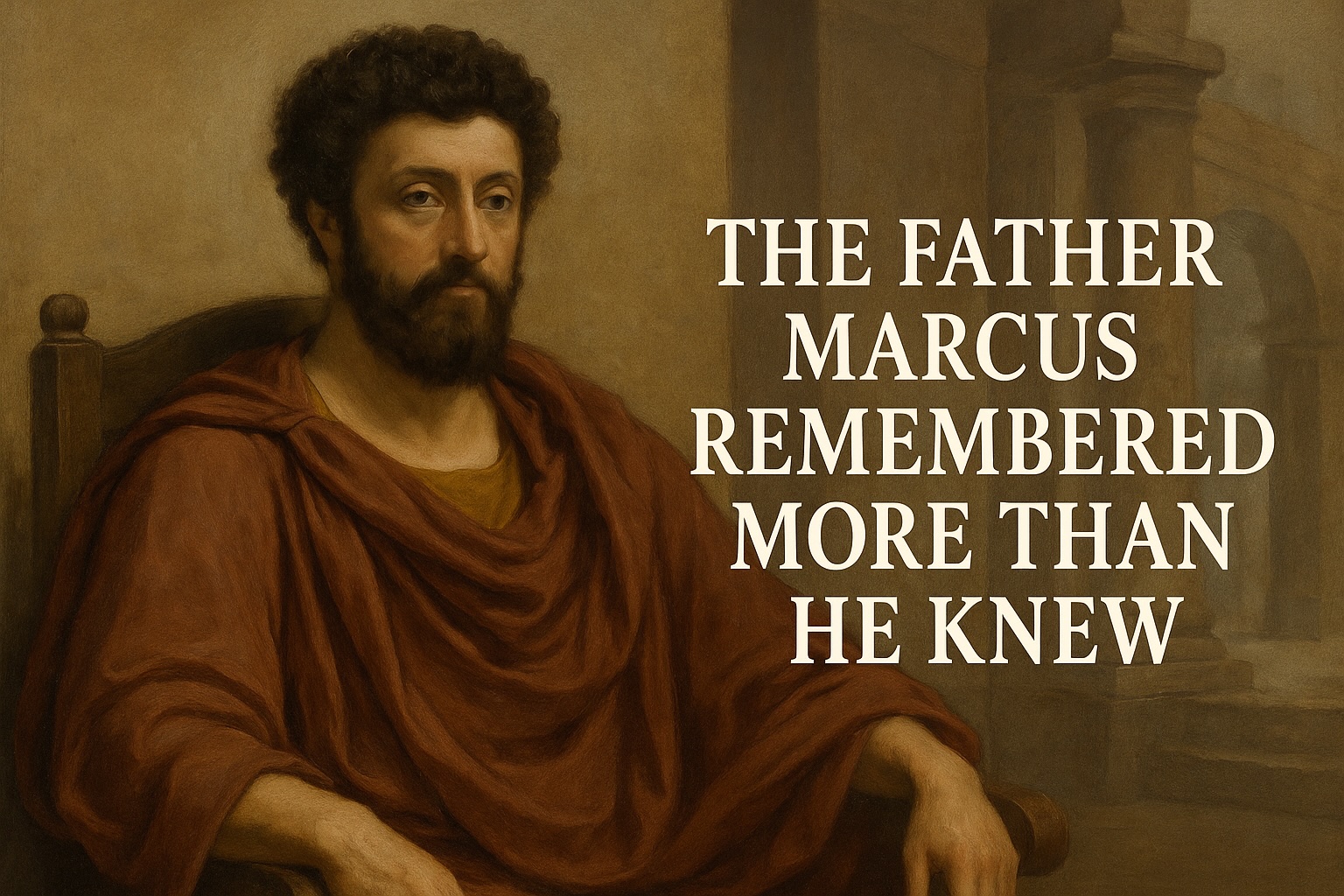
The Father Marcus Remembered More Than He Knew
Marcus Aurelius lost his father, Marcus Annius Verus, when he was a child. There was no long apprenticeship under a living parent, no daily corrections at the table or lessons on the march. What he received instead was a legacy: the way others spoke of his father, the stories repeated in the household, the quiet weight of a name that meant steadiness without spectacle. In Book I of Meditations he writes, “From the reputation and remembrance of my father, modesty and a manly character.” It’s a stark admission that our deepest teachers can be reputation and memory—the durable residue of someone’s choices.
Reputation as a Lagging Indicator of Character
Reputation is a system output, not a performance. It accumulates. It’s built from small, repeated acts that survive scrutiny and time. Because it lags, you can’t change it in a day, and you can’t fake it under sustained observation. You don’t own your reputation; other people hold it in trust. That’s why it teaches: it reflects the pattern of your decisions, not the intentions you claim.
Stoicism values integrity and consistency. Reputation is the trace those qualities leave in a community. Reputation judges differently than applause. It discounts theatrics and rewards reliability. It remembers who showed up when the water was cold, not who spoke well on warm days.
Memory as a Social System
Memory is how a family, a crew, or an organization integrates experience. It’s a distributed record of what mattered. In a ship’s log, the entries that changed the voyage aren’t always dramatic—weather observed, fuel burn noted, a small vibration traced to a failing piece of equipment. Over time, those notes become the history of prudence. They teach the next watch what to look for.
In companies and teams, institutional memory functions the same way. It retains what was truly costly, what was avoided, who was dependable, and who cut corners. It’s not sentimental. Like any system, it’s shaped by what you feed it and how you retrieve it. If you want honest memory, you need mechanisms that preserve it—logs, after-action reviews, decision records—and a culture that actually consults them.
“Manly Character,” In Context
Translations render Marcus’s phrase as “manly character,” pointing to steadiness, courage, and self-command. In contemporary terms: composure under pressure, restraint in success, responsibility for outcomes. It’s paired with modesty for a reason. Strength without restraint inflates ego; restraint without strength becomes timidity. Together, they form posture—how you carry responsibility when no one is looking and when everyone is.
What Reputation Teaches in High-Stakes Work
-
Maritime command: A captain’s reputation is built in maintenance days and weather windows, not photo ops. The crew remembers who inspected the bilge, who pushed back on an optimistic departure, who stayed on the bridge when visibility closed. That memory shapes behavior more than any speech.
-
Engineering leadership: Architecture choices leave a long tail. Teams remember leaders who favored boring, durable decisions over flashy, fragile stacks; who wrote clear ADRs; who took blame in postmortems and gave credit in launches. The codebase remembers too, in outages avoided and latency stable.
-
Military and service: Small violations compound. The division does not forget the leader who cut a safety corner, or the one who owned a failure and fixed the standard. Memory enforces a discipline that orders cannot.
-
Humans and AI: In a world of automation, accountability must be legible. Reputation and remembrance are reinforced by audit trails, explicit escalation paths, and human-in-the-loop decisions. If you can’t trace why a decision was made, trust decays, no matter how accurate the model.
Designing for Right Remembrance
If memory is a system, design it.
-
Keep a real log. Whether ship, code, or company, record decisions, assumptions, and conditions. Logs are humility on paper.
-
Hold brief, honest debriefs. Focus on mechanisms, not personalities. Capture what failed and what prevented failure.
-
Make standards operable. Checklists, runbooks, and drills turn values into behavior. You are remembered for the habits you institutionalize.
-
Prefer transparency over theater. Quiet, consistent reporting outlives charisma. Publish the decision, the rationale, and the rollback plan.
Practices That Build a Reputation Worth Having
-
Be predictable in the fundamentals: on time, prepared, clear.
-
Speak last, decide once. Listen long enough to see the whole system, then commit.
-
Choose durable over novel when stakes are high.
-
Surface risk early, without drama. Name uncertainty and set guardrails.
-
Repair what you break, directly and promptly.
-
Credit others in public; correct yourself in public.
-
Keep commitments small enough to keep and large enough to matter.
-
Write to clarify your own thinking; share to clarify the team’s.
-
Draw boundaries around automation. Explain the limits of your tools, not just their power.
None of this is performative. It’s maintenance. Reputation accrues like seaworthiness—through inspection, tightening, and restraint. You don’t notice it when the weather is fair. You rely on it when it’s not.
The Quiet Authority of Remembrance
Marcus learned modesty and steadiness not from lectures but from how his father was spoken of—what endured in the household long after the man himself was gone. That’s a hard metric and a fair one. Live so that the system around you—crew, team, family—remembers you for composure over noise, responsibility over posture, judgment over cleverness. The test isn’t whether people agree with every choice. It’s whether, in the aggregate, your choices formed a pattern worth relying on when the stakes were real.
If this perspective aligns with how you want to lead and build, subscribe to The Rissler Perspective for more reflections on clarity, systems, and responsible judgment.