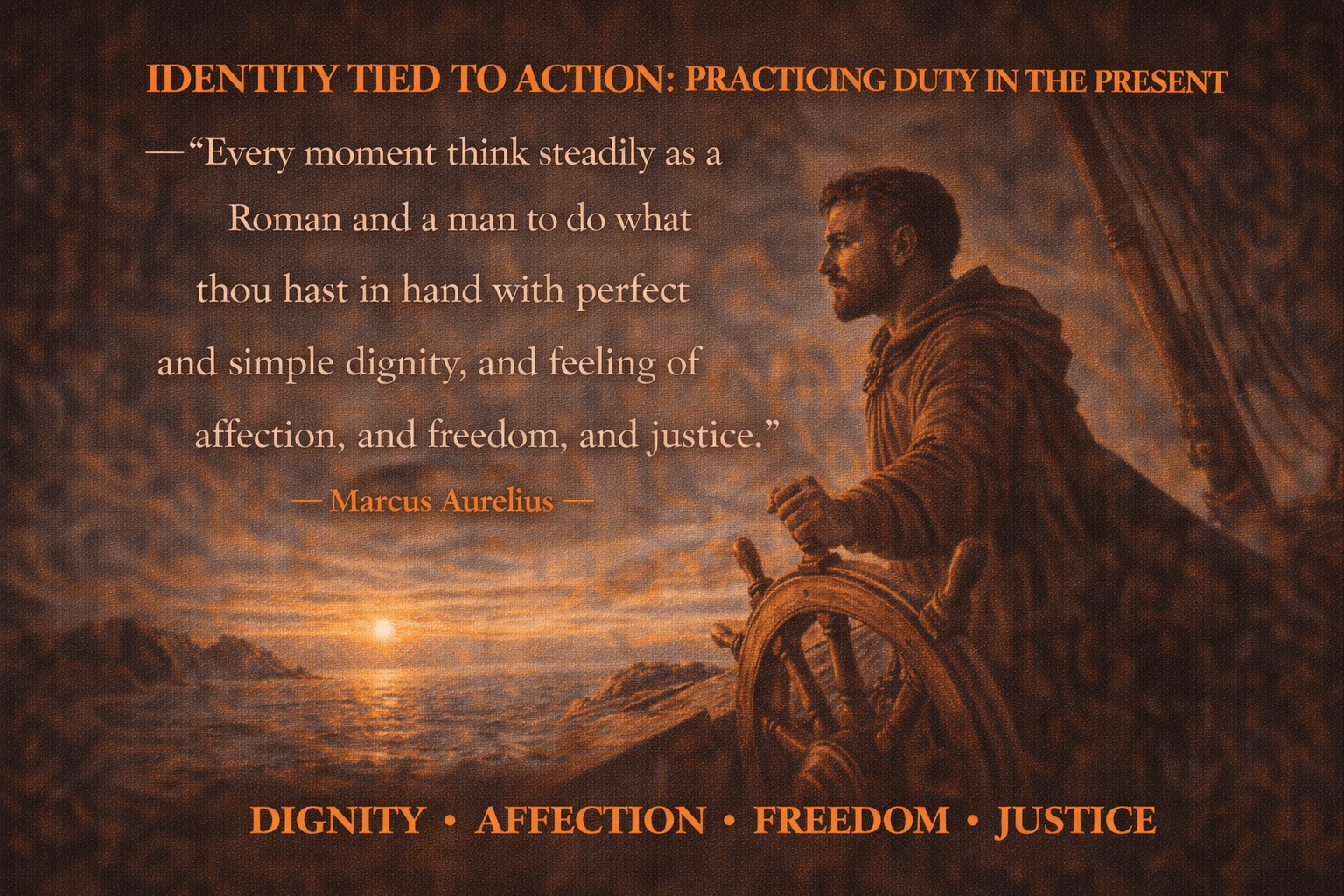
Identity Tied to Action: Practicing Duty in the Present
“Every moment think steadily as a Roman and a man to do what thou hast in hand with perfect and simple dignity, and feeling of affection, and freedom, and justice.”
Marcus Aurelius ties identity to action. Not titles. Not intentions. How you handle the task in front of you is who you are. In Book II of Meditations, he makes virtue operational by grounding it in role and responsibility: do your duty, here and now, with the right posture. The work is ethical, but it’s also practical. Systems—technical, organizational, and personal—depend on it.
Role Creates the Frame for Judgment
“Roman and a man” is not nostalgia; it’s scope. Your role clarifies what good looks like in a given moment.
-
As a captain: safety of vessel and crew.
-
As an engineer: reliability over novelty.
-
As a leader: clarity and accountability.
-
As a person: fairness and restraint.
Most failures I’ve seen weren’t a lack of raw intelligence. They were failures of role clarity under pressure. People optimized for the wrong thing: speed over safety, cleverness over reliability, personal credit over team outcome. Identity divorced from duty becomes performance. Identity tied to duty becomes judgment.
Four Constraints That Shape Action
Marcus offers four constraints for the work “at hand.” They are not abstractions; they’re operational guardrails.
-
Dignity: Carry the work without theatrics. Don’t leak your emotions onto the team.
-
Affection: Care for people and the system. Assume shared purpose, not adversary.
-
Freedom: Maintain internal independence. Don’t let fear, flattery, or urgency own you.
-
Justice: Act proportionally and fairly. No hidden costs pushed onto others.
These are constraints, not moods. Under load, constraints protect the system from you, and you from yourself.
Doing the Work in Front of You
The Stoic ethic is single-threaded attention. Do the next necessary thing well. In software, this means controlling work-in-progress. In seamanship, it’s conning the boat before you check the chartplotter. In leadership, it’s addressing the hard conversation now, not “after the quarter.”
The practice looks plain:
-
Define the smallest complete action that moves the system to a safer state.
-
Execute it with care.
-
Reassess with fresh information.
-
Repeat without drama.
Performance improves, not because you worked faster, but because you forced clarity where it was previously diffused.
When Theory Meets Weather
At 0300 on a crossing, the engine-room alarm panel lit up: cooling water pressure increasing. The forecast was good; the calendar was tight. The temptation was to nurse the system to keep schedule. The duty was to keep the crew safe and the engine alive.
-
Dignity: Secure the voice, give clear directions, and avoid speculation.
-
Affection: Bring the least fatigue to the person who will open the hatch, and keep eyes on the captain who looks rattled.
-
Freedom: Don’t let the ETA dictate engineering decisions.
-
Justice: Don’t trade a few hours saved for a 100 hours of maintenance deferred onto someone else.
We throttled down, redistributed loads, checked intakes, and diverted course to stay in calmer water while we isolated the issue. The logbook looks boring. It should.
A similar pattern holds in incident response for software. An elegant patch at 2 a.m. is ego. Rolling back to last known good is duty. Dignity is the quiet postmortem. Justice is the plain write-up that credits the team and names the faulty assumptions.
Systems Thinking: How Duty Scales
“Do what is in hand” scales through design:
-
Reduce coupling: Independent components make local duty clear and recoverable.
-
Visible intent: Standing orders, checklists, and design docs align action under stress.
-
Graceful degradation: Systems that fail soft give humans room to choose well.
-
Feedback with memory: Logs and after-action reviews turn action into learning without blame.
A system that demands heroics is a system designed for failure. Duty should find you prepared, not improvising your way out of preventable traps.
Humans and AI: Tools, Not Masters
Intelligent systems can sharpen judgment if they’re bound to purpose.
-
Use AI to clear noise: summarize logs, surface anomalies, check assumptions.
-
Keep humans as the decision boundary: authority lives with those who bear consequences.
-
Encode ethics in workflows: permissions, approvals, and audit trails express justice more reliably than slogans.
-
Preserve reversibility: freedom includes the ability to back out of a bad path quickly.
Automation without understanding is fragile. Clarity without context is incomplete. The operator remains responsible for what the machine enables.
Habits That Operationalize Virtue
Turn the principle into muscle memory:
-
State intent before action: “Given my role, the objective now is X.”
-
Time-box decisions: Decide what must be decided now; defer what can wait.
-
Minimize work-in-progress: Close loops. Open fewer new ones than you close.
-
Log decisions: Record what you knew, why you chose, and what you expected.
-
Run quiet, honest postmortems: No theater, no blame, just causal chains and next actions.
-
Set standing orders: Pre-commit to safe defaults when stress is high.
-
Care for people: Check fatigue, rotate duty, protect attention. Affection is operational.
None of this is exotic. The rarity is consistency.
Identity Accumulates
Mastery isn’t declared. It’s inferred from a long record of ordinary choices made under constraint, in public view, with consequences. Identity emerges as the sum of actions taken in role, with dignity, affection, freedom, and justice. Over time, systems shape behavior, and behavior shapes systems. If you want a different identity, make different choices—one task, one watch, one deployment, one release at a time.
The invitation from Book II is simple and stern: tie who you are to how you handle what’s in front of you. Not tomorrow. Now.
If this approach to leadership and systems resonates, subscribe to The Rissler Perspective for future essays and field notes.