
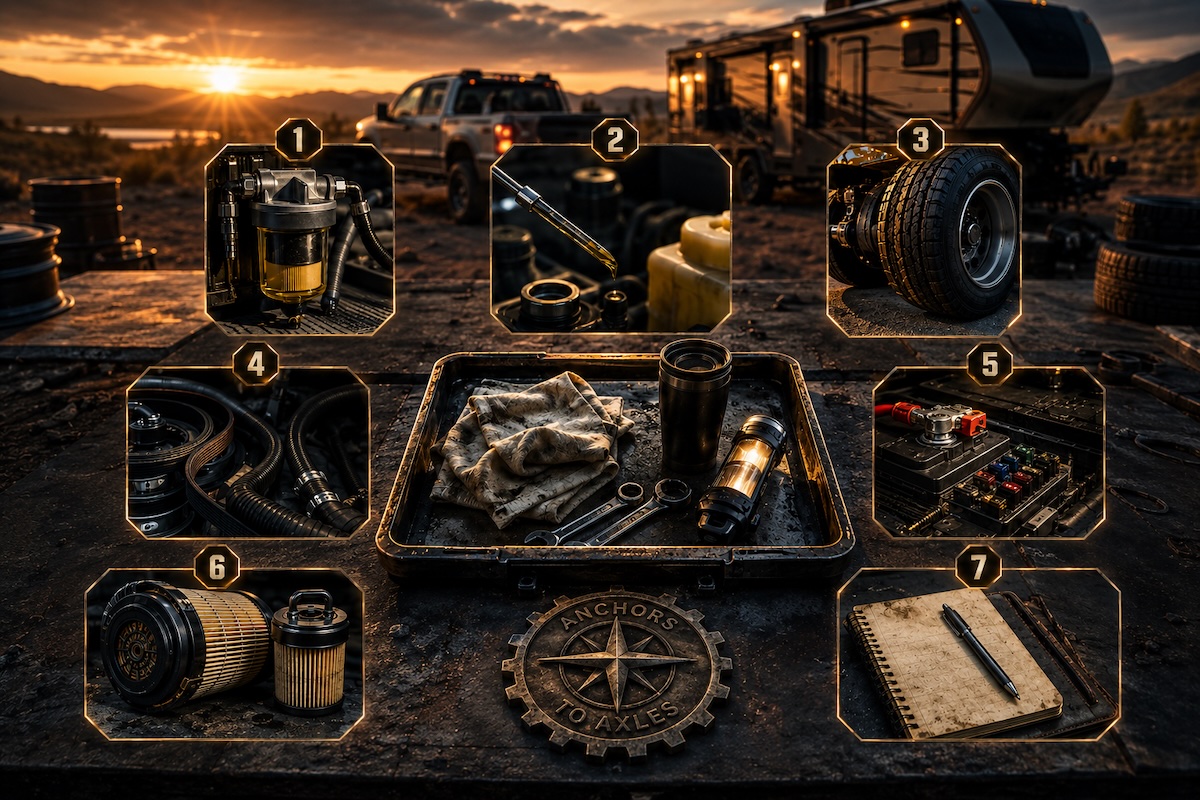
Top 7 Maintenance Habits That Cut Breakdowns in Half
From Diesel Rituals to Axle Checks You Can Do in 10 Minutes
If you spend enough time living between a yacht and a tow rig, you learn two things fast:
- Everything mechanical will eventually fail.
- You can somewhat choose how and where it fails.
These are the maintenance habits that have saved us from roadside tow trucks and marina horror stories. None of them are fancy. Most take less than 10–15 minutes. But stacked together, they’ve cut surprises way down — both on the 74’ Hatteras motor yacht and on the trucks, trailers, and RVs that keep the land side rolling.
1. The 5‑Minute Engine Room Walkthrough (Every Time You Move)
Before we leave the dock, we do a quick “eyes, ears, nose, touch” run through the engine room. Same concept applies to a truck or motorhome — just a smaller space.
What we check:
- Fluid leaks: Oil drips under engines and transmissions, coolant crust around hose fittings, diesel sheen in the bilge.
- Belts and hoses: Cracks, glazing, loose clamps, shiny “rub spots” where something’s chafing.
- Filters and strainers: Fuel filter bowls for water or debris, seawater strainers for grass, shells, plastic.
- Unusual heat or smell: Hot wiring smell, burning rubber, diesel odor where it shouldn’t be.
Why it matters: most “sudden” failures were screaming at you days earlier. A 5‑minute ritual catches the loose clamp before it’s a blown hose 20 miles offshore.
Pro tip: do the same with your tow vehicle or Class A — quick look under the hood, glance at the ground, check belt tension, look for wet spots. It’s not glamorous, but it’s cheaper than a flatbed.
2. Cold-Start Diesel Rituals That Save Your Wallet
Whether it’s the big diesels in the Hatteras or a 3/4‑ton truck towing a fifth wheel, cold starts are when you do the most damage — or the most prevention.
Our routine:
- Let the gauges tell the story: On start-up, we watch oil pressure rise quickly, then settle. Voltage should come up and stay steady. Any weird flicker or slow rise is a clue.
- Listen for new noises: Knocks, ticks, or a squeal that wasn’t there last week. We don’t ignore them.
- Warm-up with purpose: We don’t idle for 30 minutes to “baby” the engines. We warm up until oil pressure stabilizes and coolant rises, then put them under light load so temps come up evenly.
Outcome: better lubrication, fewer cold-shock issues, and early warning when something inside is getting tired.
Apply this to your pickup, Sprinter, or diesel pusher: watch your gauges, don’t hammer it cold, and don’t dismiss new sounds as “probably nothing.”
3. The 10‑Minute Axle & Towing Inspection Before Every Trip
The quickest way to ruin a great trip? A failed axle bearing or a shredded trailer tire in the middle of nowhere.
Here’s the 10‑minute routine we run before towing:
-
Tires:
- Check pressures with a real gauge, not just the truck’s TPMS.
- Look for sidewall cracks, uneven wear, bulges, or cords showing.
-
Lug nuts:
- Quick check with a torque wrench, especially after tire rotations or new wheels.
-
Hubs & bearings:
- Put your hand on each hub after a short test drive; a hot hub compared to others is a red flag.
-
Suspension & hardware:
- Visual check of leaf springs, U-bolts, shackles, and hangers. Anything bent, cracked, or moving weirdly gets attention now, not later.
-
Safety gear:
- Breakaway switch cable, safety chains, hitch pin, and wiring plug — all actually connected and not half worn through.
On the yacht side, it’s the same concept, different hardware: shaft seals, rudder posts, and stabilizer gear get a quick look before a long run. Moving parts under load deserve respect.
4. Fuel System Discipline: Filters, Water, and “Bad Diesel” Paranoia
“Bad fuel” gets blamed for a lot. Sometimes it’s true. Often it’s years of ignored fuel system maintenance.
What we do on the water:
- Primary filters you can see through: Clear bowls on Racors so we can see water or sludge.
- Regular drain & replace cycles: We don’t wait for problems — filters have a calendar, not just a “when it’s bad” schedule.
- Fuel tank management: We don’t run tanks bone-dry, and we don’t leave them sloshing around near empty for months (condensation is real).
On the road:
- Quality diesel, quality filters, and not ignoring the first hiccup under load. If the engine stumbles on a hill, we don’t pretend it didn’t happen.
Result: fewer injector issues, fewer clogged filters at the worst possible moment, and less mystery around “why did it die right now?”
5. Electrical Reality Checks: Batteries, Connections, and Corrosion
Life between anchors and axles means living on batteries — house banks, starting batteries, trailer batteries, solar systems. Most electrical “mysteries” are loose connections and tired batteries.
Our habits:
- Monthly visual inspection: Look at every battery bank — swollen cases? Corrosion? Loose clamps? Frayed cables?
- Tight & bright: Clean terminals, tight lugs, dielectric grease where appropriate. We don’t wait for green fuzz to grow a garden.
- Load awareness: If voltage sags hard under normal load, we don’t just upsize the inverter — we test the batteries.
- Labeling everything: Panels, fuses, disconnects. Future-you will thank present-you when something trips at 2 a.m.
On the yacht, a loose ground can shut down navigation. In an RV, it can kill your fridge or starve your inverter. Neither is fun when conditions are ugly.
6. Annual “Kneepads and Flashlight” Inspection Day
Once or twice a year, we block real time for an unglamorous but trip-saving habit: crawling into every forgotten corner.
On the boat, that means:
- Under bunks, behind panels, under the flybridge console.
- Looking for moisture, rust, delamination, chafe points in wiring and hoses.
- Checking seacocks, clamps, and through-hulls.
On the road side:
- Crawling under the truck, trailer, or RV.
- Looking for frame rust, cracked welds, chafed brake lines, missing bolts, sagging tanks, and creative “repairs” from previous owners.
This is when we find the stuff that isn’t on anyone’s checklist — the zip tie that’s now sawing through a coolant hose, the wire slowly rubbing on a frame rail, the clamp that’s one trip away from failing.
7. The Logbook: Boring to Keep, Magic When Things Go Wrong
We track more than just hours and miles. We track patterns:
- When filters were last changed
- What oil we used and how much the engine consumed
- When bearings were repacked
- Which batteries are new, which are living on borrowed time
- Any odd noises, smells, temps, or error codes
Why it works:
- Patterns show up before failures. Rising oil consumption? Frequent fuel filter changes on one engine? Same hub running hotter every trip? That’s not random.
- It kills the “I think we did that last year” lie we tell ourselves.
Whether it’s a notebook on the chart table, a spreadsheet, or an app, the logbook is the quiet co-captain of both yacht life and RV life.
Living between anchors and axles means embracing the grind behind the freedom — the checks, the grease, the “wait, what’s that smell?” moments that keep the adventure going.
If you want more real-world maintenance lessons, system breakdowns, and behind-the-scenes fixes from both the 74’ Hatteras and the rigs on the road, follow along with Anchors to Axles — where we share what breaks, how we fix it, and how to keep your own journey rolling and floating longer.