Top 5 Fuel-Saving Tactics That Worked on Twin Diesels and Tow Rigs (And When Not to Bother)
Fuel burn is the tax we all pay for adventure. Whether it’s twin diesels pushing a 74’ Hatteras or a loaded truck dragging a travel trailer up a 6% grade, every mile or nautical mile has a cost.
Over the last few seasons, we’ve tried a lot of fuel-saving strategies on both sides of the Anchors to Axles life: Empire’s twin diesels and our tow rigs. Some tactics actually moved the needle. Others were a waste of effort, or even made the experience worse.
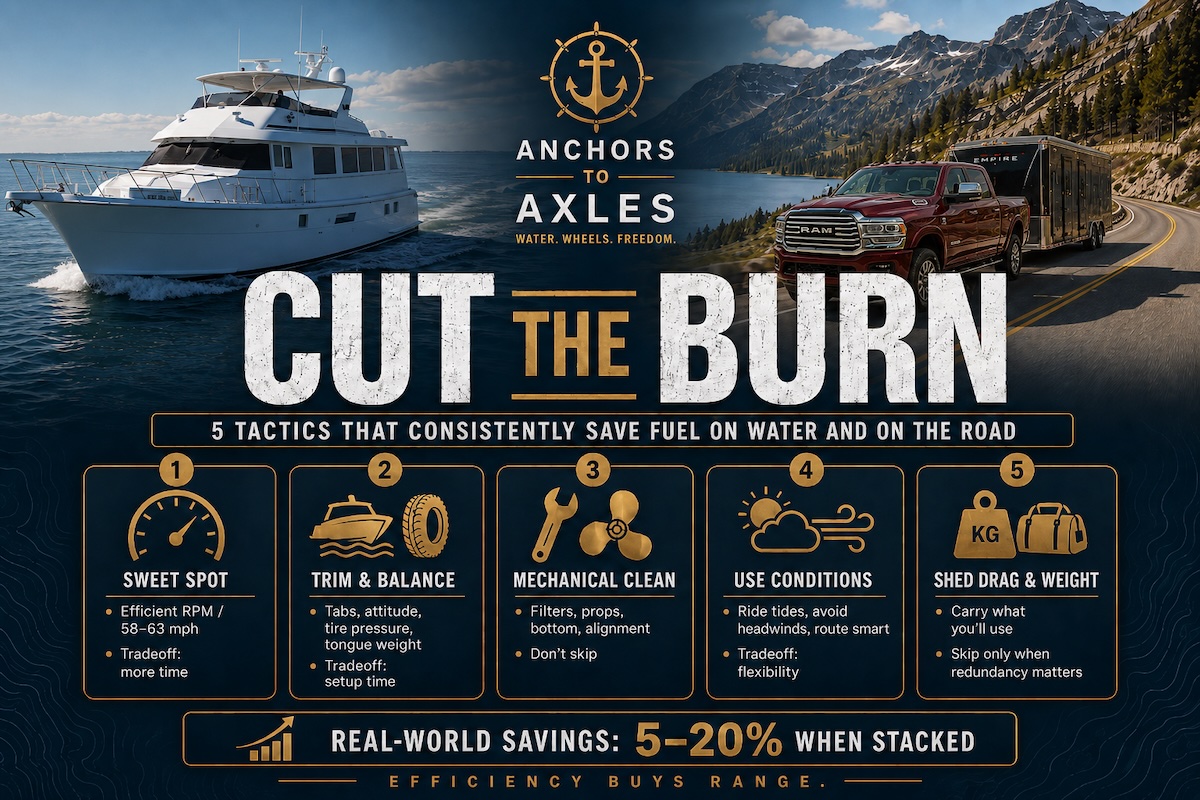
Here are the five fuel-saving tactics that actually worked for us—along with the tradeoffs, and the honest truth about when they’re just not worth the hassle.
1. Running the “Sweet Spot” Instead of the “Instagram Speed”
On both boats and trucks, there’s a speed that looks good on video and a speed that your fuel gauge actually likes.
How it worked on the yacht
On Empire’s twin diesels, we logged fuel burn at different RPMs and sea states. The pattern was obvious:
- Idle to slow displacement (6–8 knots): Lowest GPH, but we enjoyed a slow trip.
- Semi-displacement “sweet spot” (around 9–11 knots): Best miles-per-gallon tradeoff for covering real distance.
- On plane (18+ knots): Fun, but fuel burn spiked fast.
By accepting that we’re a cruising boat, not a speed boat, we landed on a “sweet spot” RPM that gave us a solid average speed with a fuel burn that didn’t make us question our life choices every time we hit the pumps.
How it worked on the tow rig
Same story on land. On long highway runs with a trailer:
- Dropping from 75 mph to 63–65 mph consistently saved 10–20% in fuel.
- The truck stopped hunting gears, EGTs ran cooler, and we arrived a little less wrecked.
Tradeoffs
- You arrive later.
- You will be passed by everyone.
- On the boat, running slower can mean getting beat up by a wind, tide or missing a weather window.
When not to bother
- Boating: When the weather window is tight or you need to beat a front, prioritize safety and comfort over saving a few gallons.
- Towing: In heavy traffic where speeds constantly surge and drop, the benefits of targeting a “perfect” speed mostly disappear.
If you remember one thing: pick a realistic cruise speed, log your burn, and stick to what the numbers, not the ego, are telling you.
2. Weight Reduction: The Stuff You Don’t Need Is Drinking Your Diesel
Every pound you drag through air or push through water costs fuel.
On the water
We went through Empire and:
- Purged old lines, rusted anchors, mystery spare parts, and “just in case” junk we hadn’t touched in years.
- Consolidated provisions and stopped trying to outfit the boat like a floating Costco.
Results weren’t dramatic on a percentage basis—the boat is heavy—but the engines felt less “luggy” coming onto a semi-displacement groove, and we shaved a little off our burn at lower RPMs.
On the road
Weight is much more noticeable in a tow rig:
- We pulled unnecessary tools, extra water jugs, some items we never used, and the crate of “someday” camping gear.
- Dumped tanks before long climbs when possible instead of hauling full fresh and gray “just in case.”
The truck accelerated easier, shifted less frantically on hills, and fuel economy bumped up by about 0.5–1 mpg on some routes.
Tradeoffs
- You will eventually need something you removed. Probably in the rain. At night.
- Constantly running light means more frequent provisioning stops.
When not to bother
- Safety gear, critical spares, and tools stay. A blown fuel line or bad impeller miles from help costs much more than a bit of extra fuel.
- If you’re going somewhere remote (long crossings, boondocking), err on the side of carrying more, not less.
Weight reduction is worth doing once or twice a year as a “reset,” not as a weekly obsession.
3. Smart Trim and Setup: Hull, Trailer, and Aerodynamics
How you sit in the water or on the road matters as much as how fast you move.
On the yacht
We experimented with:
- Trim tabs: Slight adjustments to bring the bow down reduced drag and smoothed our ride at semi-displacement speeds.
- Hull cleanliness: A clean bottom and props made a noticeable difference. After a haul-out and proper cleaning, we saw around 5–10% better fuel economy at the same RPM.
On the tow rig
We chased some low-hanging fruit:
- Trailer setup: Correct hitch height, weight distribution, and tires at spec prevented the rig from squatting and dragging through the wind.
- Simple aero tweaks: Securing items in the bed, removing a roof basket when not needed, and keeping the front of the trailer clean and sealed.
None of this turned a brick into a Prius, but it smoothed out the tug-of-war feeling and added incremental savings that stacked up over long trips.
Tradeoffs
- Proper setups take time and a bit of money (haul-outs, alignment, WDH adjustments).
- Aero “mods” can go too far—bolt-on gimmicks don’t always equal real-world savings.
When not to bother
- Don’t obsess over minor add-ons if your fundamental setup is wrong. Fix trim, balance, and cleanliness before you buy another magic spoiler or fuel-saving snake oil.
4. Maintenance First: Tuning, Filters, and Fluids
This is the boring one. It’s also where we saw some of the most reliable gains.
What changed on the boat
- Fresh fuel filters and clean air filters.
- Staying on top of valve adjustments, injector health, and turbo inspections.
- Keeping cooling systems efficient so engines run at proper temperature.
We didn’t suddenly gain 20% efficiency, but we did stop losing efficiency to neglected systems. The engines started cleaner, smoked less, and hit target RPMs without drama.
What changed on the tow rig
- Regular oil and fuel filter changes, especially before towing seasons.
- Correct tire pressures (including the trailer).
- Alignment after suspension tweaks or long, rough trips.
We saw more consistent fuel economy and fewer ugly surprises—like dragging a misaligned trailer for 1,000 miles and paying for it at the pump the whole way.
Tradeoffs
- Upfront cost and time, especially on bigger marine engines.
- You need to track a maintenance schedule instead of “fix it when it breaks.”
When not to bother
You should always bother with basic maintenance. Skipping it rarely “saves” you anything in the long run, in fuel or money.
5. Route and Conditions: Planning Around Wind, Waves, and Grades
The route you choose and the conditions you accept make a massive difference in fuel burn.
On the water
We started planning legs around:
- Tide and current: Running with the current whenever possible. A 1–2 knot push over a long day is huge for both time and fuel.
- Wind and seas: Avoiding head seas that force us to slow down and burn more just to maintain comfort and safety.
A well-timed departure could mean arriving earlier on less fuel, simply by letting the water work with us instead of against us.
On the road
We looked at:
- Major grades and passes, choosing gentler routes when time allowed.
- Forecast wind. A brutal headwind can kill fuel economy; sometimes shifting a drive by a day or adjusting direction first makes a real difference.
Tradeoffs
- More planning, less spontaneity.
- You might decide to wait out a day instead of charging ahead, which can mess with schedules.
When not to bother
- If the only “better” route adds four hours of driving to save a couple gallons, it’s not worth it.
- Sometimes you just have to grind into the wind or ride out choppy seas to stay on schedule or ahead of weather.
Here’s the honest takeaway:
- Reasonable fuel-saving habits (sweet-spot speeds, good maintenance, smart routing) absolutely pay off.
- Obsessive micromanagement of every knot or mph sucks the fun out of the journey and doesn’t always save that much.
Fuel is part of the cost of choosing this life—on the water and on the road. The goal isn’t to turn your yacht or tow rig into a science project; it’s to be intentional enough that you’re spending money on memories, not on avoidable waste.
If you want more real-world numbers from twin diesels, tow rigs, and the messy middle where yacht life meets RV life, follow along with Anchors to Axles. We’re sharing the wins, the screwups, and the fuel receipts from both sides of the adventure.