
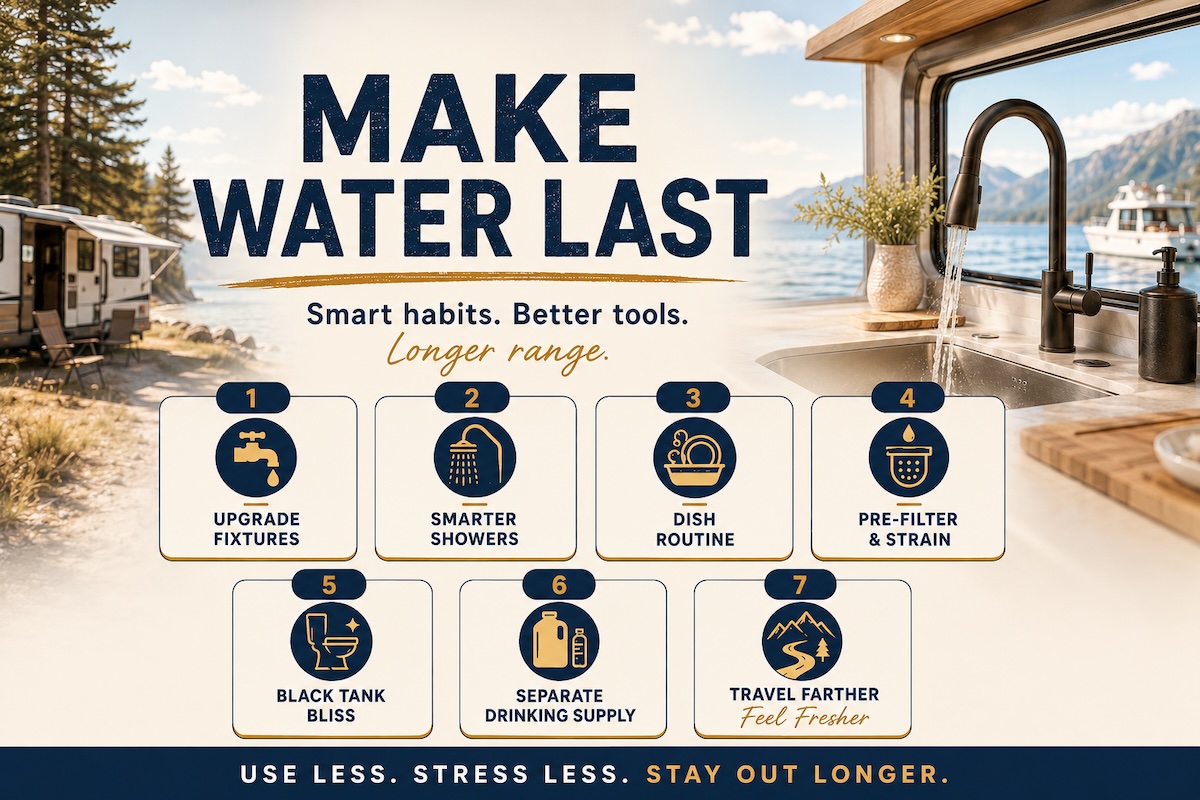
7 Ways to Stretch Fresh Water (and Tame Your Tanks) Without Feeling Like You’re Roughing It
Running out of fresh water or filling your gray/black tanks too fast is the fastest way to turn “freedom on wheels/keel” into “where’s the nearest dump station/marina?” On our 74’ Hatteras Empire and in our rigs, water and tank management quietly dictates how long we can stay off-grid, which anchorages we pick, and how far from civilization we’re willing to wander.
The good news: you don’t have to shower with baby wipes and call it “adventure.” With the right habits and a few smart upgrades, you can stretch fresh water and keep gray/black tanks under control without feeling like you’re roughing it.
Here are the top 7 strategies we use on both boat and rig.
1. Re-think Showers: Comfort First, Waste Last
Showers are usually water-killer #1. You don’t need to skip them—you just need to change how you take them.
On boats and rigs, we use:
-
Navy-style showers, done right
- Water on: get wet.
- Water off: soap up.
-
Water on: quick rinse.
It feels civilized if you’ve got good pressure and warm water.
-
High-efficiency shower heads
Swap to a low-flow (1.5–2.0 GPM) head with a flow-stop switch. Big difference in usage, small difference in comfort. -
Short, more frequent showers instead of marathon steam sessions
Three-minute rinses every day or two beat one 20-minute shower that kills the tank.
Pro tip: Time one “normal” shower at home and measure the water used, then compare it to your reduced-flow setup. Seeing the real numbers makes the “navy shower” feel like a win, not a sacrifice.
2. Turn the Galley/Sink into a Water-Efficiency Zone
Most people dump water down the sink without thinking about where it’s going: straight into the gray tank. On a boat or rig, every unnecessary gallon shortens your off-grid window.
Habits that change the game:
-
Use a wash basin inside the sink
One small tub for wash water, a light trickle for rinse. You’ll use a fraction of the water and know exactly how much is going into the tank. -
Scrape dishes hard before washing
Less gunk, less water needed, and less smell in the gray tank. -
Two-stage dishwashing
- Stage 1: Wipe/scrape food, quick pre-rinse.
- Stage 2: Wash all dishes in a basin, then a fast group rinse.
-
Paper towels or reusable rags as “pre-wash”
Wipe pans and plates before they ever see water.
3. Upgrade Your Fixtures: Let Hardware Do the Heavy Lifting
This is where small investments pay off on every single trip.
On both boat and rig, prioritize:
-
Faucet aerators
Aerators mix air into the flow, cutting water use while keeping pressure feeling strong. Cheap, easy to install. -
Touch or lever faucets
Easier on/off means fewer “oops, it’s still running” moments. -
Smart water pump settings
- Check for leaks and drips—annoying at home, trip-killing afloat.
- Dial pressure to a sweet spot: comfortable but not firehose-level.
On Empire, we treated fixtures like a comfort upgrade. The side effect was using less water. On the rigs, the same swaps stretched our boondocking days by 1–2 extra nights.
4. Get Serious About Drinking Water: Filtered, Not Wasted
Drinking water shouldn’t feel rationed. You just need to make it efficient and easy.
System ideas that work for both sea and land:
-
Dedicated drinking water tap
Install a small filtered faucet at the galley sink. Now you’re not running full sink flow every time you want a glass. -
Under-sink filter or compact RO system
- Extended-life carbon filter = no constant bottled water runs.
- On a yacht with bigger capacity, RO can turn sketchy dock water into something drinkable.
-
Refillable jugs or bladders
- Keep a couple of 5–7 gallon jugs for drinking/cooking only.
- Top them off when water’s available, so your main tank isn’t your only lifeline.
Why it matters: When you trust your drinking water setup, you stop relying on cases of plastic bottles and weird dock spigots. That’s less waste, less storage clutter, and more days away from town.
5. Manage Gray and Black Tanks Like a Pro, Not a Victim
Tank capacity is your real “freedom meter.” Blunt truth: people give up on anchorages and boondocking spots not because they run out of fuel—but because they run out of tank space.
Simple black tank rules that keep you sane:
- The classic rule: If it didn’t come out of you, don’t put it in the toilet (yes, that includes half a roll of paper). Use marine/RV paper or go light.
-
Keep flushes short and decisive
You’re aiming for “just enough” water to move waste, not a freshwater Niagara. -
Vent and treat tanks properly
Odor usually comes from poor venting and biology, not lack of chemicals. Good venting + occasional treatment = less shame when guests open the head door.
Gray tank strategies:
- Use that wash basin so you know how fast you’re filling it.
- Run hotter water every few days with a bit of biodegradable soap to reduce grease buildup.
- Don’t treat gray like a trash can. Food chunks, coffee grounds, and oils all add stink and clogs.
6. Reuse When You Can (Without Feeling Gross)
You don’t have to recycle every drop like a spaceship. Just be smart.
Simple, non-gross reuse tactics we actually live with:
-
Hand-wash water → pre-rinse water
Lightly soapy sink after washing hands? Use it to pre-rinse a dish or wipe the counter. -
Leftover clean-ish ice melt → rinse water
Melted cooler ice can rinse sandy feet, shoes, or the cockpit steps.
These little habits add up over a week. The goal isn’t perfection—it’s just not wasting good water on bad jobs.
7. Use Tech to Know, Not Guess: Gauges, Meters, and Alarms
Nothing kills the vibe like discovering your fresh tank is empty halfway through a shampoo—or your black tank is mysteriously full on day two.
Worth-the-money upgrades:
-
Accurate tank level sensors
If your stock sensors lie (and most do), upgrade to external/ultrasonic sensors that read more reliably. -
In-line water meter on your fresh system
Know exactly how many gallons you’ve used and what a “normal” day looks like. Once you know your pattern, you can plan anchorages and boondocking stops with confidence. -
Simple alarms
A high-level alarm for black tanks can save you from the “overflow of doom” in a marina or tight campsite.
On Empire, seeing numbers changed everything—we stopped being surprised. On the road, we can look at the meter and know: “We’ve got three more showers and two days of dishes before we need a dump station.”
The Payoff: More Freedom, Less Drama
Stretching fresh water and taming gray/black tanks isn’t about suffering through “camping rules.” It’s about trading mindless waste for intentional comfort so you can:
- Stay longer in the good anchorages and remote camps,
- Avoid sprinting back to civilization for a pump-out,
- Travel further between marinas, campgrounds, and service stops,
- And actually enjoy the yacht/RV lifestyle you worked so hard to build.
At Anchors to Axles, we’re still learning, still breaking stuff, and still tweaking systems on both hull and axles—but every upgrade and habit shift buys us more time where we really want to be: on the hook, off the grid, and nowhere near a dump station line.
Want more real-world lessons from life aboard Empire and out on the road? Follow Anchors to Axles for honest stories, gear breakdowns, and behind-the-scenes systems talk that actually helps you stay out there longer.