In Praise of Saying Less: Communication as a Discipline
Most environments reward sound, not substance. Meetings fill calendars, timelines flood with opinions, and inboxes refill on arrival. The appearance of communication is constant. Actual communication—words chosen in service of truth, clarity, and understanding—is rare. The difference is not academic. It shapes decisions, trust, and outcomes.
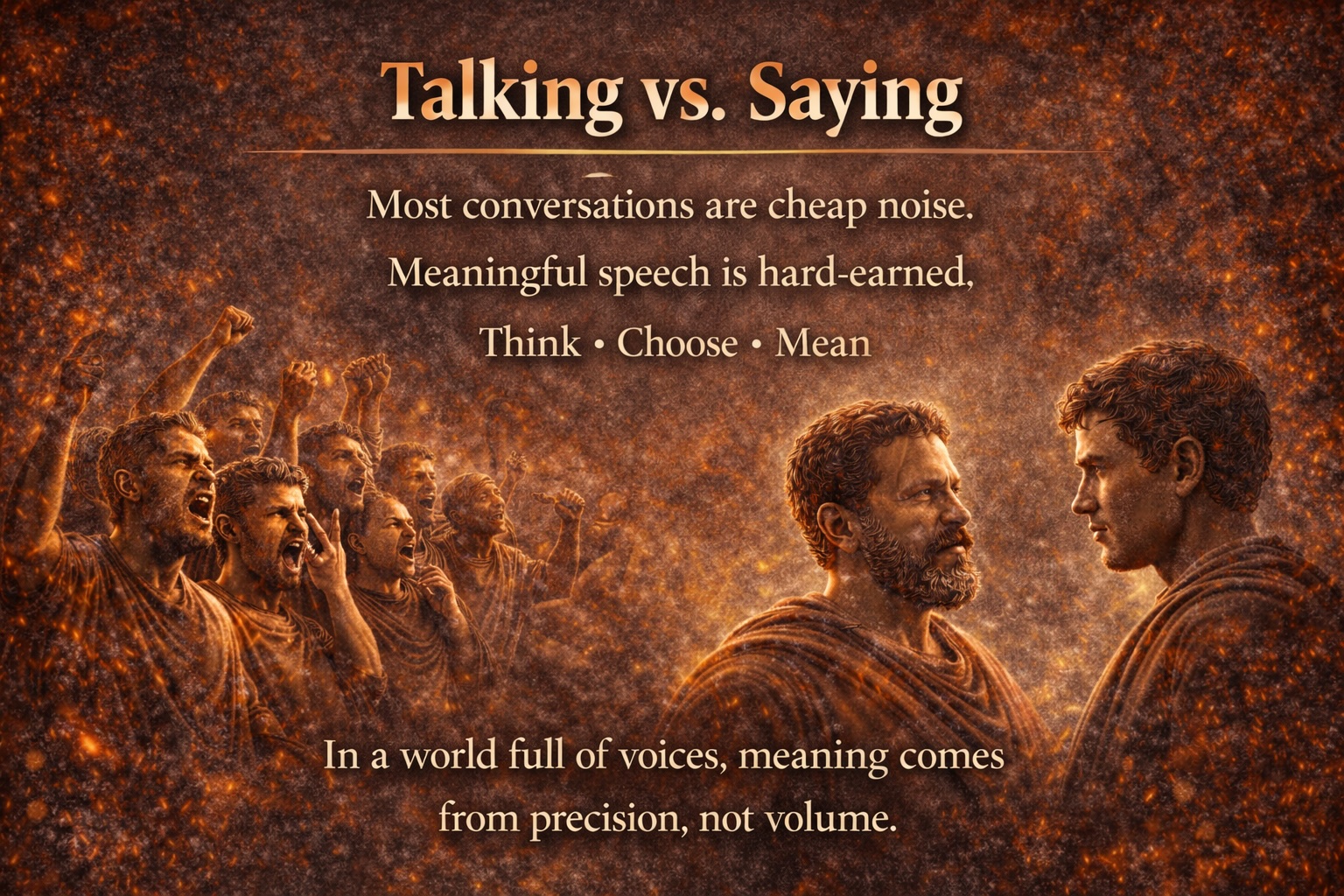
Noise masquerades as communication when it signals identity, fills silence, or maintains visibility. It calms the sender more than it informs the receiver. In leadership, engineering, operations, and any domain where stakes are real, this is dangerous. Meaning comes from precision, not volume.
Talking vs. Saying Something
Talking is easy. Silence is uncomfortable. Depth is risky because it entails responsibility. Saying something is different. It requires:
-
Thinking before speaking: What decision is this for? What is known, unknown, and assumed?
-
Choosing words carefully: Definitions, scope, and constraints prevent drift.
-
Accepting responsibility for meaning: If your words move people, you own the consequences.
Teams feel the difference immediately. Precision reduces cycles. Ambiguity creates churn and unforced errors.
How Systems Reward Noise
Systems shape behavior. Many of our technical and organizational systems incentivize output over signal.
-
Social platforms reward visibility and speed, not accuracy or reflection.
-
Status cultures prize “updates” over decisions, creating a fog of activity.
-
Tooling overload—alerts, dashboards, threads—produces attention debt and reactionary thinking.
In maritime operations, radio discipline exists for a reason: brevity, confirmation, and clarity prevent collisions. On a bridge at night, words are few and explicit. The same principle applies in software and leadership. When a system can punish vague language with real consequences, precision becomes normal.
Silence Is an Instrument
Silence is not absence; it is a tool. Used deliberately, it creates space for thought and reduces error rates.
-
In briefings, a pause before speaking increases alignment. People absorb intent.
-
In negotiations, silence tests if the other side can articulate their position without prompting.
-
In reviews, silence replaces defensive chatter with evidence.
Brevity codes, checklists, and standing orders exist because silence plus structure outperforms improvisation plus noise.
Practical Ways to Increase Signal
If you lead, you set the standard. A few practices consistently improve clarity and reduce noise:
-
Start with intent: One sentence that states the purpose. “The purpose of this note is to decide X by Y.”
-
Define terms: Agree on vocabulary up front. Ambiguity multiplies silently.
-
State constraints and tradeoffs: Budget, time, safety margins, non-negotiables. Constraints focus creativity.
-
Separate facts, interpretations, and bets: What is observed, what is inferred, and what we are willing to stake.
-
Use decision logs: Record the decision, rationale, options rejected, and the trigger for revisiting. Memory is a poor system.
-
Timebox discussion: Allocate space for exploration, then decide. Endless debate is a form of avoidance.
-
Write before meeting: A concise brief read in silence beats a deck performed aloud.
-
Close with ownership: Who decides, by when, and what will be measured.
These are small disciplines with compounding effects. They turn communication into an operating advantage.
Precision and AI: Tools, Not Oracles
AI amplifies the signal you provide—or the noise. Automation without understanding is fragile. Pair human judgment with machines by being precise:
-
Write the problem statement before prompting.
-
Provide context, constraints, and definitions; specify the decision you’re advancing.
-
Ask for failure cases, edge conditions, and tradeoffs, not just answers.
-
Treat outputs as drafts to be interrogated, not truths to be accepted.
The boundary is simple: we are responsible for outcomes. Tools assist; they do not absolve.
Leadership: Accountability for Words
Leaders create culture through language. If you reward performance theater, you’ll get more theater. If you model clarity, restraint, and responsibility, the organization will calibrate accordingly.
Practical leadership behaviors:
-
Ask, “What decision does this support?” before any update.
-
Insist on falsifiable statements: “We expect X by Y because Z; we’ll revisit if A or B occurs.”
-
Protect thinking time and preserve silence in meetings. Don’t fear pauses.
-
Remove metrics that reward noise. Measure resolved decisions, reduced rework, and fewer surprises instead.
The goal is not fewer words; it is better words. The outcomes follow: better decisions, calmer teams, fewer crises manufactured by our own communication debt.
When Words Must Carry Weight
Real environments compress time and expand uncertainty. A squall line closing on a harbor entrance. A production incident at peak traffic. A payroll problem on Friday. In these moments, language is a safety-critical system. Clear intent, tight loops, and defined boundaries turn pressure into action rather than panic. Afterward, disciplined debriefs turn action into learning.
We do not earn trust by speaking more. We earn it by speaking meaningfully, acting accordingly, and being willing to be held to our own words. In a world full of voices, meaning comes from precision, not volume. The practice is simple, but not easy: think, choose, own.
If this resonates, your already one step ahead!