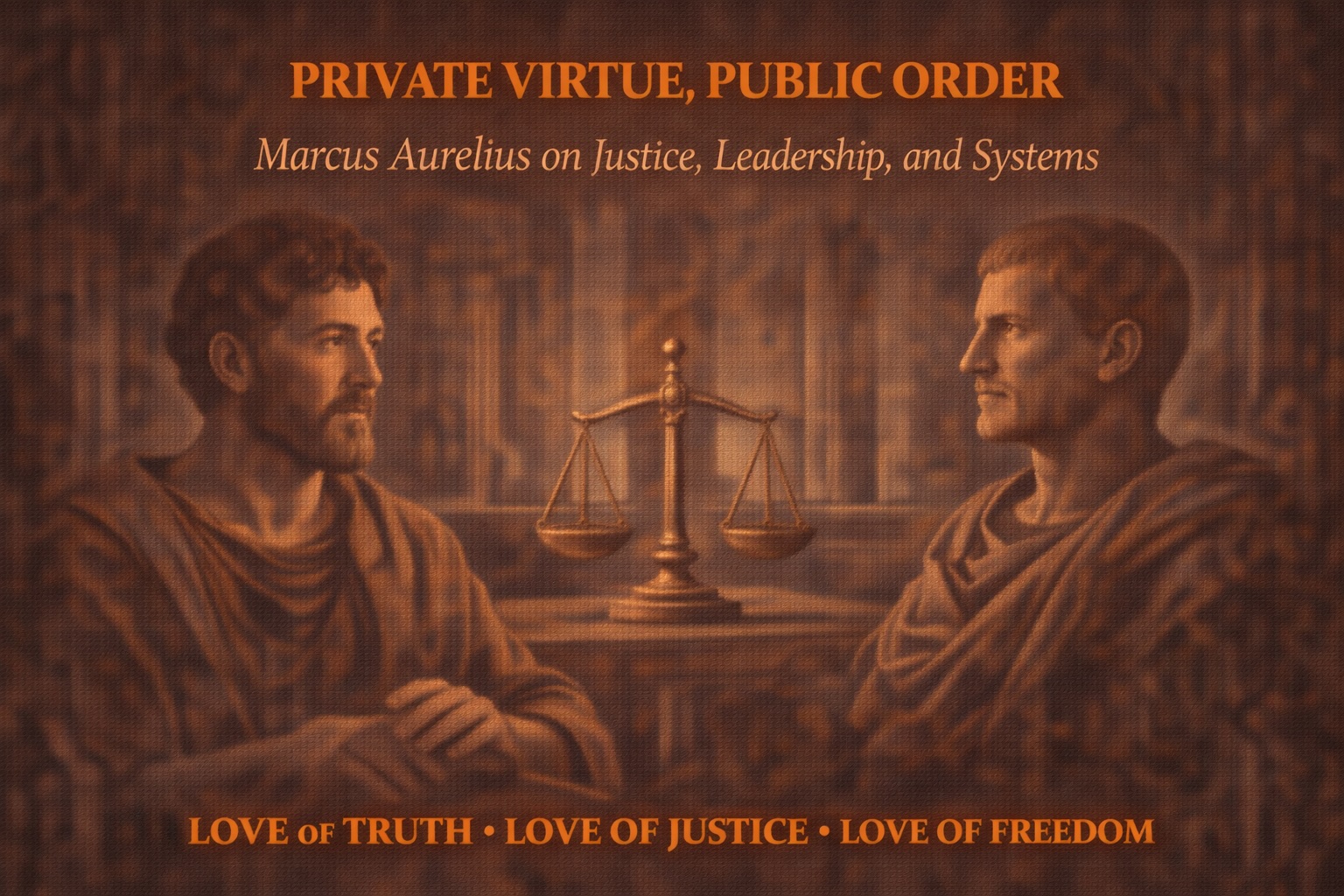
Private Virtue, Public Order: Marcus Aurelius on Justice, Leadership, and Systems
In Book I, Section 14 of Meditations, Marcus Aurelius thanks his brother Severus for convictions that bind the private to the public: love of kin, love of truth, love of justice. Through Severus he encounters Thrasea, Helvidius, Cato, Dion, and Brutus—figures of principled dissent—and an ideal polity with equal law and equal freedom of speech. He also notes a government that respects the freedom of the governed, and a life made steady by philosophy, generosity, and openness.
This is not abstract piety. It is the blueprint of a system. Private virtue becomes the architecture of public order. Consistency in a person is reliability in a team; frankness in a leader is predictability in an institution; justice in motive becomes justice in process.
Stoic justice as system design
“Same law for all” is not a slogan. It is a design constraint. Systems fail where exception becomes habit and privilege hides risk. If your organization tolerates a parallel rulebook for “high performers,” you do not have law—you have discretion. Discretion scales politics, not performance.
“Equal freedom of speech” is an operational requirement. Safety-critical domains—ships, aircrews, surgical teams—depend on the weakest voice being able to interrupt the strongest rank. The Roman ideal reads modern when mapped to error-reporting, postmortems, and dissent channels that actually change decisions.
“Government which respects the freedom of the governed” reframes authority as stewardship. Power is justified when it enlarges the agency of those subject to it. In practice, that means:
-
Clear constraints and goals, not micromanagement.
-
Access to information symmetrical across levels where possible.
-
Decisions explained with reasons, trade-offs, and time horizons.
This is how rule of law looks inside a company, a ship’s watch bill, or a software architecture: stable interfaces, documented contracts, and the same behavior for the same input, regardless of who calls the function.
Private virtue as operational discipline
Marcus lists habits that translate into dependable leadership:
-
Consistency and steadiness: People can anchor to you under pressure.
-
Disposition to do good and give readily: You invest in capability, not just output.
-
Cherishing good hopes and believing you are loved by your friends: You assume good faith without becoming naive; trust is an asset with compounding returns.
-
No concealment of opinions: Your team doesn’t have to guess your intent.
The last point matters. Intent kept private becomes volatility in others. In military planning, commanders state intent so subordinates can adapt without constant supervision. In engineering, we publish decision records. In seamanship, you call out hazards plainly. Openness is not exhibitionism. It is clarity that reduces cognitive load and prevents error.
Truth, equality, and speech as safety mechanisms
Stoic justice is often framed as virtue ethics. It is also risk management.
-
Truth reduces noise. If status reports are theater, systems drift until reality enforces itself catastrophically.
-
Equality checks blind spots. When rules are elastic for insiders, feedback loops break and small failures accumulate.
-
Freedom of speech is an early warning system. You do not want a culture where people “wait for the captain to see it.” You want the lookout to call the reef now.
The Roman names Marcus learned—Thrasea, Helvidius, Cato, Dion, Brutus—signal a throughline: principled dissent as a feature, not a bug, of a healthy polity. The same holds in modern teams: dissent is not disloyalty when anchored in shared purpose and reason.
Applying Meditations Book I to modern leadership
Translate the section into practice:
-
Write and share your operating principles. Make your red lines explicit. Let people predict you.
-
Standardize the rules. No exceptions for revenue, tenure, or proximity to power. If there is an exception, document the rationale and sunset it.
-
Build real speech channels. Anonymous reporting, open AMAs, facilitated postmortems. Reward the first report of an uncomfortable truth.
-
Explain decisions. State the problem, options considered, costs, and why you chose one path. Close the loop when new information changes your mind.
-
Maintain philosophical discipline. Read, write, audit your motives. A daily practice is not self-help; it is maintenance of judgment.
-
Lead with generosity. Budget for training, mentorship, and tools. Give credit publicly and feedback privately.
-
Assume good faith, verify performance. Trust as default; measurement as protection for the mission and the people.
Failure modes to watch
-
Erosion of equal law: special deals, opaque comp. Counter with transparent bands and published processes.
-
Performative speech: “We value feedback” with no change. Counter with tracked actions from each review.
-
Hidden intent: shifting expectations, private scorecards. Counter with explicit goals and regularly updated priorities.
-
Opaque automation: systems making consequential decisions without audit. Counter with human-in-the-loop and clear accountability.
Humans and AI: rules, speech, and accountability
If technology is to amplify judgment, it must live inside Marcus’s polity. Same law for all means models follow documented policies with auditable behavior; no privileged outputs for favored users. Equal freedom of speech means any operator can challenge an AI conclusion and escalate. Respect for the governed means those affected can understand the decision path in plain language. Automation without these constraints is not efficiency; it is abdication.
Kingly government that respects freedom
Marcus’s phrase is often misunderstood. The point is not to idealize monarchy; it is to assert that legitimate authority increases the freedom of those under it. On a vessel, a strong captain sets clear rules so the crew can act decisively without waiting. In a product team, leadership defines constraints and purpose; engineers own methods. Authority that hoards agency breeds fragility. Authority that distributes agency builds resilience.
Justice as daily maintenance
On a boat, corrosion is patient. So is injustice in systems. You do not defeat it once; you inspect, clean, and recoat. Equal law, real speech, and respected freedom are not slogans to print on values pages. They are daily practices—checklists, habits, and boundaries—that keep the hull sound when the weather turns.
If you found this useful and want more grounded reflections at the intersection of leadership, systems, and judgment, subscribe to The Rissler Perspective or explore the latest essays.