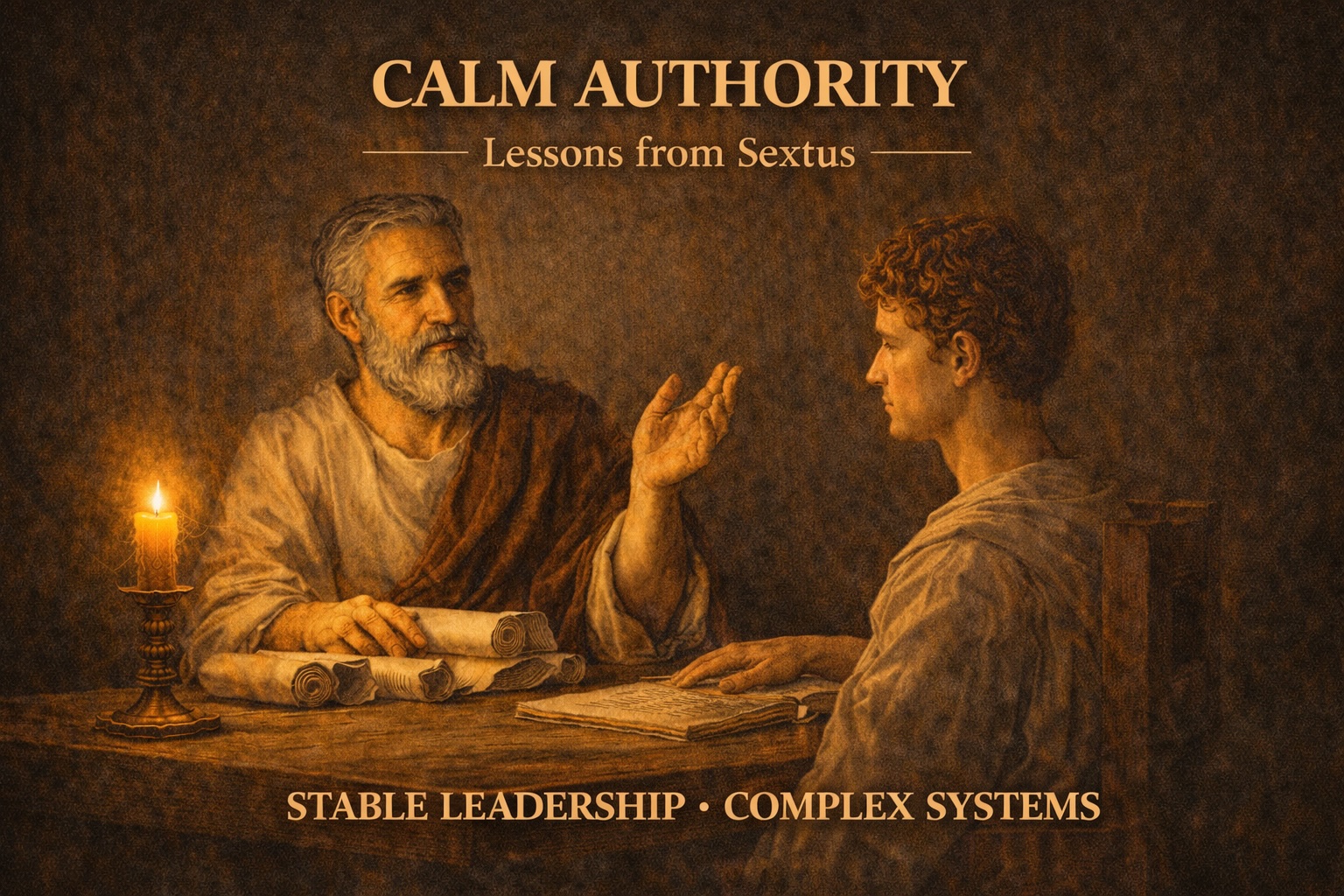
Calm Authority: Sextus and the Operating System of Stoic Leadership
Book I, Section 9 of Meditations reads like a field manual for moral authority. Marcus Aurelius doesn’t praise charisma or conquest; he names dispositions: benevolence, gravity without affectation, tolerance for the untrained, adaptability without flattery, and knowledge without ostentation. It’s a blueprint for leadership under pressure—calm presence as a stabilizing force in complex systems.
This isn’t abstract philosophy. It’s operational guidance for anyone responsible for real outcomes.
Authority Without Force
Sextus led like a steward, not a proprietor. “A family governed in a fatherly manner” is not indulgence; it’s accountability grounded in care. People followed him not because he demanded it, but because he made it easier to do the right thing—and harder to do the wrong thing—without theatrics.
In practice:
-
State expectations plainly, then protect the team from noise so they can meet them.
-
Make it safe to surface uncertainty early. You can’t correct what people hide.
-
Treat discipline as a form of care: standards that preserve safety, trust, and tempo.
On a boat, the captain’s tone sets the sea state inside the hull. In an architecture review, the lead’s clarity determines whether engineers optimize for speed or durability. In both cases, moral authority is felt in the quiet: fewer surprises, fewer politics, less judgment.
Emotional Moderation as System Control
Sextus “never showed anger” and was “entirely free from passion,” yet “most affectionate.” That’s not coldness; it’s control. In systems terms, an angry leader tightens the feedback loop until it oscillates. The signal-to-noise ratio collapses.
Practical controls:
-
Pre-commit your escalation thresholds: what triggers a firm “stop,” what warrants a measured “watch,” and what passes with a note. Decide in advance when calm breaks.
-
Use briefings, not rants. State facts, implications, decision, and rationale in that order.
-
Keep post-incident reviews blameless but exacting. Target process, not dignity.
Moderation widens the deadband so the system can self-correct. People bring you hard truth sooner when your presence lowers variance rather than amplifies it.
Adaptable, Not Accommodating of Sloppiness
Marcus notes that Sextus “readily accommodated himself to all,” making interaction more agreeable than flattery. Adaptability here means adjusting the interface to the person without compromising the protocol.
Translation for modern teams:
-
Reframe for context without changing the decision. What you say flexes; what you stand on does not.
-
Tolerate the untrained; do not tolerate the uninterested. Curiosity earns patience. Indifference earns a reset.
-
Treat confusion as a design bug. If a smart, motivated person struggles, improve the interface: clearer definitions, simpler paths, better defaults.
This is how you avoid gatekeeping while maintaining standards. You make doing the right thing the path of least resistance.
Quiet Competence Over Performance
Sextus “possessed much knowledge without ostentation,” could “discover and order the principles necessary for life,” and “express approbation without noisy display.” The emphasis is method over theater.
Operationalize it:
-
Write principles as constraints, not slogans. “We don’t trade integrity for velocity” is a constraint. It bites in real decisions.
-
Maintain living checklists for recurring risks: deploys, hiring, vendor selection, vessel maintenance. Make the next right action obvious.
-
Keep praise specific and private first. Public recognition is meaningful when it’s earned and scarce.
Quiet competence builds a culture where credit flows to work, not volume.
Habits That Make Calm Contagious
A few durable practices:
-
Decision journal: record the situation, options, chosen path, and reasons. Revisit on a schedule, not just when results are loud.
-
Red-team rituals: assign a rotating critic to challenge assumptions before commitment. Normalize dissent as a service.
-
Weekly “interests of friends” review: ask whose success you are actively advancing—mentorship, introductions, unblocking. Stewardship requires a calendar.
-
Incident lexicon: agree on levels (informational, minor, major) and the comms protocol for each. Vocabulary prevents drama.
-
“Approve quietly.” Offer concise, timely approvals with a why. Don’t make people beg for green lights.
These structures make the leader’s disposition portable. They scale.
Humans and AI: Amplify Judgment, Don’t Replace It
Sextus ordered principles; he did not outsource them. Use AI to sharpen thinking, not to abdicate it.
Good uses:
-
Pre-mortems: simulate failure modes and generate checklists to address them.
-
Summarization: compress long threads into decision-ready briefs without losing nuance.
-
Option generation: propose alternative architectures or plans, then pressure-test them with human context.
Guardrails:
-
Keep the decision log human-signed. If you can’t explain the call without the model, you’re not ready to make it.
-
Never let convenience dictate ethics. Automation without understanding is a fragility multiplier.
Tools should lower entropy, not leadership.
Measuring Moral Authority
You can’t A/B test character, but you can observe leading indicators:
-
The quality and speed of upward truth.
-
The presence of principled dissent before, not after, commitments.
-
Escalations framed in risk and impact, not emotion.
-
Retention of your most demanding people.
-
Postmortems that produce fewer repeats and shorter time-to-lesson.
When these improve, calm authority is diffusing through the system.
Closing the Loop
Sextus models a leadership stance that’s both demanding and humane: benevolent, restrained, adaptable, methodical. It looks quiet from the outside. Inside the system, it feels like clarity. Under stress, it holds.
Pursue this, and the work will speak for you.
If this perspective aligns with how you lead and build, subscribe to The Rissler Perspective for future essays on judgment, systems, and durable practice.