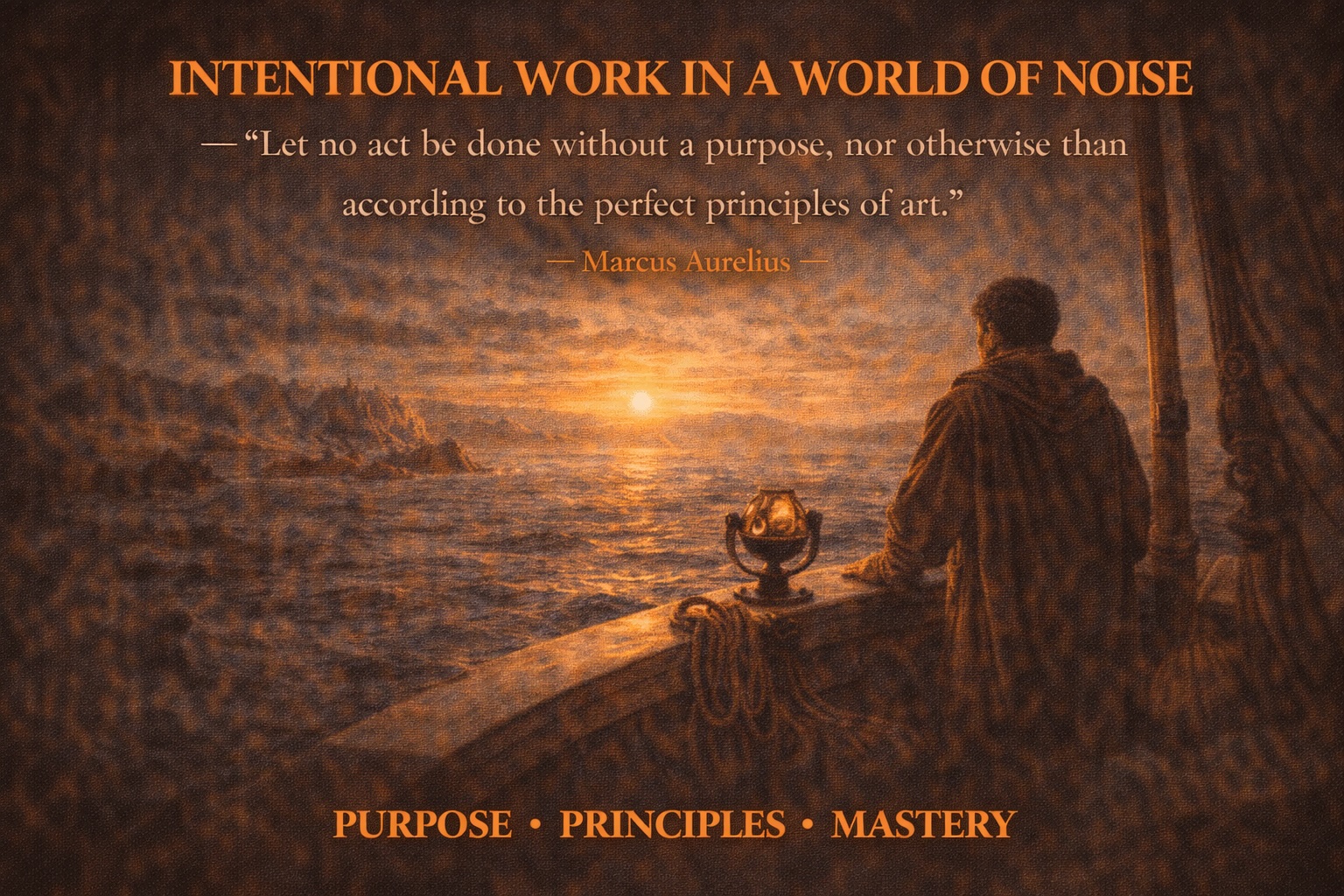
Intentional Work in a World of Noise
“Let no act be done without a purpose, nor otherwise than according to the perfect principles of art.”
Marcus is not asking for perfection. He’s asking for craft. The point is not to act less, but to act with intention and according to principles you are willing to be judged by. In leadership, engineering, seamanship, or building a company, that alignment is the difference between activity and progress.
Purpose as the First Constraint
Purpose is not a slogan. It is a constraint that shapes choices under pressure. When you name the purpose plainly, trade-offs get simpler, not easier.
-
In software architecture: “Deliver a stable release before quarter-end without growing operational risk.” That rules out clever rewrites. It favors small, reversible changes.
-
At sea: “Enter the harbor safely with a tired crew and failing radar.” That might mean anchoring outside to wait for daylight. Seamanship is restraint under uncertainty.
-
In leadership: “Protect trust while enforcing standards.” That means clear expectations, documented feedback, and consequences measured to the lapse—not a public performance.
Clarity of purpose removes options you never really had and makes the remaining ones legible.
The “Principles of Art” Today
Principles are not abstractions; they are the disciplined methods of a craft. The “art” here is tradecraft—the rules that keep you from fooling yourself.
Some examples I return to:
-
Proportion: Solution size matches problem size.
-
Reversibility: Prefer decisions that are easy to undo.
-
Visibility: Make state, risk, and ownership observable.
-
Economy: Remove what is unnecessary before adding anything.
-
Durability: Bias toward options that age well.
-
Responsibility: Name a single accountable owner for the outcome.
On a boat, these are doctrine: keep water out, keep people aboard, keep the rig standing. In a system, they’re invariants: data integrity, idempotency, least privilege. In a team, they’re norms: single-threaded ownership, simple plans, quiet competence.
You write these down before you need them, test them in drills, and adjust them after each real event. That is how principles become muscle memory.
Practiced, Not Improvised
I have stood on a dark bridge wing, nearing a narrow inlet with a cross current. The chart was clean; the radar was lying. The crew was capable but tired. We had a plan and abort points marked. We turned away, waited for light, and went in later without drama. The most important decision was made earlier: “If we can’t meet our minimums, we stop.”
The same in production operations. A noisy alert at 2 a.m. looks urgent. Before the crisis, define: logging level changes allowed at night, config flags you can flip, data you must not touch, and when to roll back. Practice partial failures. Practice the rollback. When it is dark, you will act according to what you have practiced.
Decision-Making Under Uncertainty
Intentional action under uncertainty is not heroism. It is procedure:
-
State the aim in one sentence. What outcome do we seek now?
-
Set success and failure markers. What would make us stop or change course?
-
Choose the smallest step that tests the thesis.
-
Prefer reversible moves. Keep options open until you must commit.
-
Name the owner and the time box. Who decides what, by when?
-
Make state visible. Write it down where others can see and challenge it.
-
Close the loop. After-action review, captured learning, updated principles.
This is slow only the first few times. Over time it becomes faster than improvisation because you pay less for mistakes and recover quicker.
Systems Shape Behavior
Systems—technical, organizational, personal—make future behavior likely. If your system rewards visible urgency, you will get theater. If it rewards clarity and closure, you will get clean handoffs and fewer surprises.
-
Build dashboards that show what matters (error budgets, on-time maintenance, unresolved decisions).
-
Create friction for high-risk moves (peer review, multi-party approval) and remove friction for safe ones (automated tests, simple rollbacks).
-
Fund maintenance. Neglected systems coerce bad choices because they remove safe options.
Integration beats optimization. A fast tool that produces decisions no one owns is noise. A disciplined process that ties intent to action to learning builds durable capacity.
AI and Tools: Amplify Intent, Not Replace Judgment
Intelligent systems are force multipliers only when pointed at clear intent. Automation without understanding is fragility disguised as efficiency.
Use AI to:
-
sharpen purpose (generate decision frames and alternatives),
-
surface blind spots (counter-arguments, failure modes),
-
check conformance to principles (security, privacy, invariants),
-
accelerate routine craft (summaries, test scaffolds, documentation).
Do not use AI to:
-
choose ends,
-
override constraints,
-
accept risk you do not understand.
Every automated action should have visible ownership, audit trails, and abort criteria. If you cannot articulate why a system did something, you cannot be responsible for it.
A Short Field Guide to Purposeful Action
Before you act, ask:
-
Why this, why now?
-
What outcome defines success? What would make us stop?
-
Which principles govern this domain?
-
What are the invariants we will not violate?
-
What is the smallest reversible step toward the outcome?
-
Who owns the decision, and how will we record it?
-
What will we learn, and where will that learning live?
Then act. Close the loop. Update the principles. Mastery is a pursuit, not a badge.
When Not to Act
Restraint is part of the craft. Do not:
-
ship when you cannot observe impact,
-
brief when you cannot be honest,
-
steer when the instrument you rely on is suspect and you have sea room to wait,
-
decide when the cost of waiting is low and the fog will lift with one pass of sunlight.
Sometimes the most intentional move is to hold course and prepare.
Closing
“Let no act be done without a purpose” is not a call to rigidity. It is an invitation to live and work as a practitioner: disciplined, clear, and accountable. Choose purpose. Build principles. Practice until they hold under pressure.
If this perspective is useful, subscribe to The Rissler Perspective for future essays on leadership, systems, and deliberate practice.