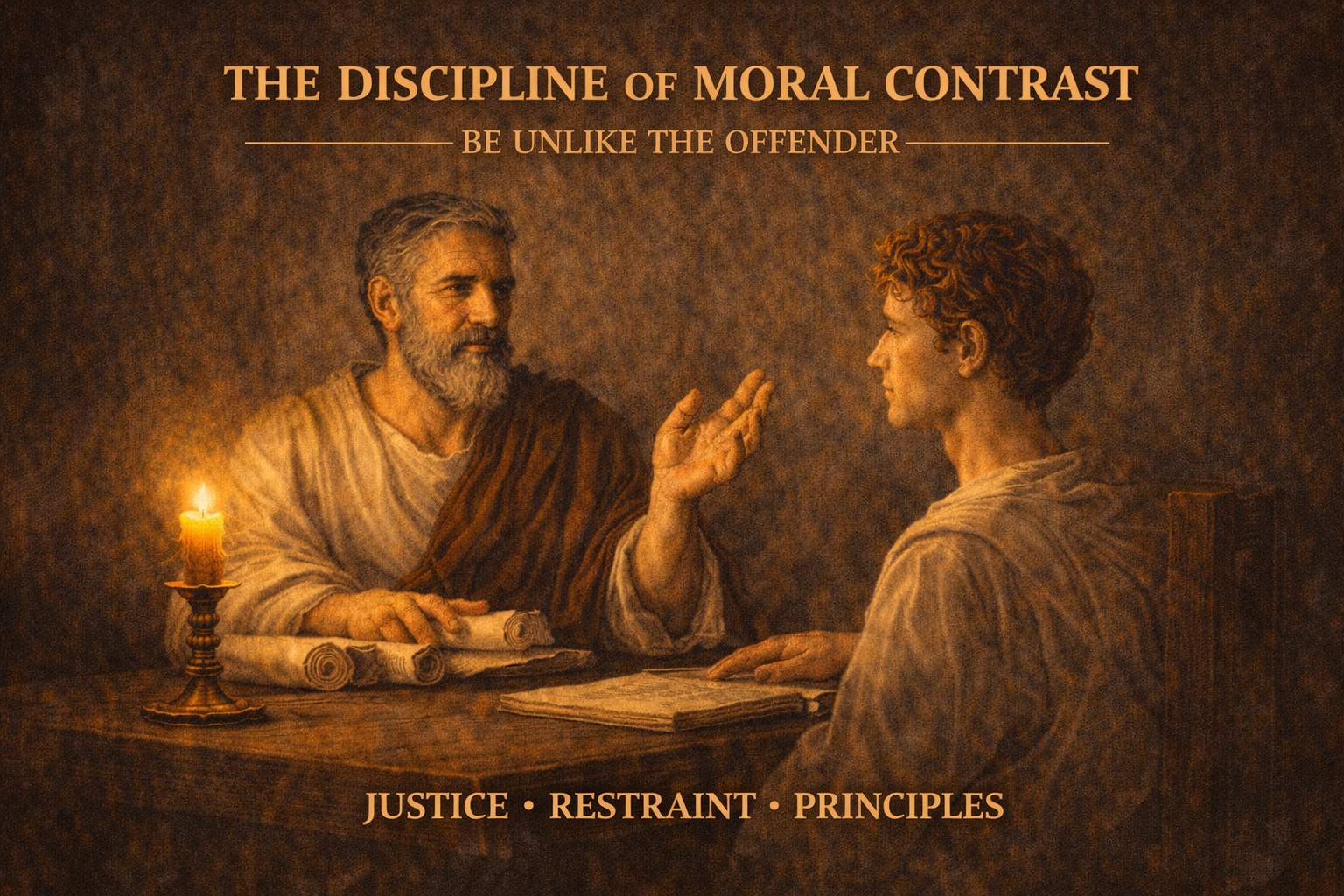
The Discipline of Moral Contrast
In Meditations — Book II, Section 15, Marcus Aurelius offers a simple counterweight to retaliation: “The best revenge is to be unlike him who performed the injury.” It reads like a moral aphorism. But in practice it is a systems decision: refuse the feedback loop that turns offense into imitation.
Stoic justice does not ignore harm. It reframes response. The standard is not superiority or theater; it is fidelity to a set of principles that remain stable under pressure. Virtue becomes the answer to offense because it prevents the escalation that weakens judgment, corrodes teams, and distorts systems over time.
What “Being Unlike” Actually Demands
“Be unlike” is not passive. It asks for three simultaneous disciplines:
-
Hold your line: maintain standards you chose under clarity, not the ones your opponent tries to impose.
-
Act within bounds: pursue accountability through proper channels, not impulse.
-
Learn without becoming: extract the lesson without adopting the behavior that caused the damage.
It is the difference between knowledge and wisdom. Knowledge catalogs the injury. Wisdom shapes the response so that tomorrow’s system is stronger than today’s.
Retaliation as a System Problem
Retaliation feels immediate and personal; in reality it is structural. In teams, ships, software, and markets, reaction creates loops:
-
Signal amplification: react in kind, and you validate the tactic. It spreads.
-
Standard erosion: the exception becomes the new rule under stress.
-
Attention tax: cycles of payback consume bandwidth needed for real work.
Aurelius’s line is not just ethical; it’s operational. You break the loop by refusing to mirror it, and by building mechanisms that make restraint executable under heat.
In an Organization
A leader gets undermined in a meeting. The instinct: counter in public, assign blame, tighten control. Short-term relief, long-term damage. The better path:
-
Address the behavior privately and promptly.
-
Clarify standards of critique (disagree openly, respect decisions, own outcomes).
-
Run a structured after-action review—on the work, not the politics.
-
Adjust incentives so constructive candor is rewarded and side-channel attacks are not.
Here, justice is not humiliation. It’s the restoration of process and trust.
In Software and Systems
A partner ships breaking changes without notice. The tempting reply: “return fire”—ship an incompatible patch. Instead:
-
Stabilize your interface; publish versioning and deprecation policies.
-
Instrument the boundary; measure dependency health.
-
Communicate a migration path and timelines.
-
If needed, change vendors—but leave a paper trail and retain professionalism.
Reliability is the outcome of steady posture, not clever retaliation. Your contract is part of your character.
At Sea
A vessel cuts across your bow, then jams the channel with insults. A hot mic invites escalation. The professional answer:
-
Keep proper lookout, adjust course early, hail clearly on the correct channel.
-
Log the incident factually.
-
If enforcement is warranted, report through the authority with time, position, and behavior.
Seamanship is restraint in tight water. You are training the crew’s eyes and nerve for the storm that actually matters.
Boundaries: Virtue Is Not Naïveté
Being unlike the offender does not mean absorbing damage indefinitely. It means:
-
Separate justice from vengeance: use contracts, courts, and governance—not rumor and sabotage.
-
Set consequences in advance: documented policies reduce discretionary anger.
-
Close access: reset credentials, terminate agreements, reassign roles. Calmly.
Restraint without boundaries is fragility. Boundaries without restraint are escalation. Integration is the aim.
Making It Practical Under Pressure
Principles fail without implementation. Build for the moment when your pulse spikes.
-
Precommitment: write your operating standards when calm—communication, escalation, conflict rules. Treat them as checklists in heat.
-
Delay mechanisms: default pause windows for major decisions after offense (e.g., “sleep one night before sending policy notices”).
-
Dual control: require a second, unemotional reviewer for punitive actions.
-
Clean logs: keep contemporaneous notes; facts discipline memory.
-
AARs that center learning: separate blame from causation. Address conduct, but do not collapse everything into character attacks.
-
Personal drills: rehearse replacement behaviors—breath, reframe, draft-then-delete, consult counsel.
Discipline is architecture for judgment, not a mood.
Humans and AI: Choosing Not to Mirror the Worst
In human-machine systems, “being unlike” has specific implications:
-
Don’t fight manipulation with manipulation. If competitors game metrics, resist the slide into dark patterns. Choose transparency and consent even if it costs short-term conversion.
-
Keep humans in the loop where stakes are real. Let AI surface anomalies; retain human authority on employment, safety, and security decisions.
-
Audit for drift. Models learn from data; data often records bad behavior. Being unlike means curating training signals and rejecting amplification of abuse.
-
Document intent. When an AI flags a “revenge” response (e.g., throttling a user who criticized you), your system should force an explicit policy check before action.
Automation without understanding is fragile; clarity without context is incomplete. AI should sharpen thinking, reduce noise, and support better decisions—not license impulsive ones.
Why Moral Contrast Works
-
It protects personal and institutional character—the only compounding asset that cannot be copied.
-
It preserves optionality by avoiding entanglements you can’t later unwind.
-
It scales. Revenge relies on you being present. Standards endure when you’re not.
When stakes are real—war rooms, wheelhouses, payroll—composure is not style. It is a safety system.
Closing
Aurelius’s sentence is not a posture; it is a practice: design yourself and your systems so that offense does not set your standard. Hold the line you set on a calm day. Take the lesson. Apply the consequence. Leave the theater.
If this perspective is useful, subscribe to The Rissler Perspective for future essays on leadership, systems, and judgment under pressure.